




Seeing the Unseeable
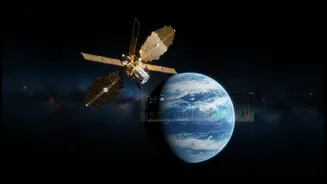
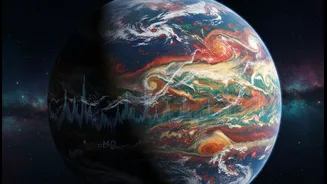
Finding water hundreds of light-years away sounds like science fiction, but it's a reality thanks to a clever technique called transit spectroscopy. When an exoplanet passes in front of its host star from our perspective, a tiny fraction of the starlight
filters through the planet's atmosphere. Telescopes like the James Webb Space Telescope (JWST) can analyse this light. Molecules in the atmosphere, including water vapour, absorb specific wavelengths, or colours, of light, leaving a unique chemical fingerprint. By reading this barcode of missing light, astronomers can determine what gases are present, turning a distant point of light into a world with a discernible atmosphere.
A Planet's Climate, Revealed
The popular imagination immediately connects water with the potential for life. While that's a powerful motivator for the search, the scientific significance of finding water vapour is much broader. Water is a potent greenhouse gas, meaning its presence is a fundamental clue to a planet's climate. Discovering water vapour helps scientists model a planet's temperature, pressure, and whether conditions might allow for liquid water on the surface. For example, the detection of water on planets like WASP-96b or GJ 9827d has allowed astronomers to build a more complete picture of their atmospheric dynamics and formation history, regardless of their habitability. It's less about finding oceans and more about understanding the basic physics of a world.
Redefining the 'Habitable Zone'
For years, the search for life has focused on the 'habitable zone'—the orbital band around a star where temperatures could allow liquid water to exist on a rocky planet's surface. However, this concept is a bit of a blunt instrument. A planet in the zone could have lost its atmosphere, or have a toxic one. The discovery of water vapour adds a crucial layer of data. It helps confirm whether a planet has an atmosphere and if the conditions are actually right for liquid water. Sometimes, a planet can be too hot, becoming a 'steam world' where any water is trapped in a steamy, inhospitable atmosphere. In other cases, a planet's atmosphere can be stripped away by its star, losing its water to space. Detecting water helps us sort the true contenders from the duds.
A Foundation for Finding Life
While water vapour itself is not a definitive sign of life, it's a critical stepping stone. Most scientists agree that liquid water is essential for life as we know it. Therefore, confirming the presence of water is the first step before dedicating valuable telescope time to searching for more complex 'biosignatures'—gases like methane, oxygen, or carbon dioxide in specific combinations that could be produced by biological processes. Finding water tells astronomers that a planet is worth a second, closer look. The JWST has already proven its ability to detect a whole menu of atmospheric chemicals, moving us from simply finding planets to truly characterising them.