






Scientists have just knocked on the door of the 'zeptoverse', a realm of reality so small it challenges the imagination. After a 40-year search, physicists at CERN's Large Hadron Collider have found evidence of one of the rarest particle decays ever seen.
What is the LHCb Experiment?
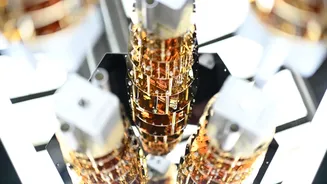
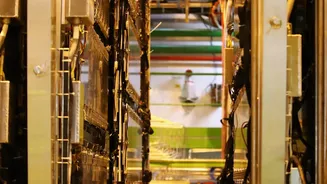
Deep beneath the French-Swiss border, the Large Hadron Collider (LHC) smashes protons together at nearly the speed of light. The LHCb, or 'Large Hadron Collider beauty' experiment, is one of four massive detectors situated along the LHC's 27-kilometre ring. Its specific mission is to study the behaviour of particles containing a 'beauty' quark, also known as a bottom quark. These particles are fascinating because they are incredibly short-lived, decaying into other particles in about one and a half trillionths of a second. By precisely measuring these rapid transformations, scientists can test our current best theory of particle physics, known as the Standard Model, and hunt for signs of new physics. An upgraded detector, which began operating in 2024, allows LHCb to collect data at a much higher rate, making it possible to spot extremely rare events that were previously invisible.
Our Best Theory of Physics (And Its Gaps)
The Standard Model of particle physics is one of science's greatest triumphs. It describes all the known fundamental particles and three of the four fundamental forces that govern the universe. However, scientists know it is incomplete. The Standard Model cannot explain some of the biggest cosmic mysteries, such as the nature of dark matter, which acts as the invisible scaffolding of galaxies, or why there is so much more matter than antimatter in the universe. To solve these puzzles, physicists are searching for phenomena that the Standard Model cannot predict. Rare particle decays are considered 'golden channels' for this search because they are extremely sensitive to the influence of unknown particles or forces that might exist at energy scales beyond the LHC's direct reach.
A One-in-Ten-Billion Event
The recent breakthrough announced by the LHCb collaboration is the first evidence from a single experiment of the decay of a particle called a B-zero (B0) meson into two smaller particles called muons. This event is astonishingly rare, predicted to happen only about once in every 10 billion B0 decays. Finding this signal is like picking out a single specific grain of sand from a hundred large beaches. After decades of searching, the team combined data from 2024-2025 with earlier results to achieve a statistical significance of 3.2 sigma. While this comfortably crosses the 3-sigma threshold for 'evidence' in particle physics, it is still short of the 5-sigma 'gold standard' needed to claim a formal discovery.
Welcome to the Zeptoverse
This discovery provides a new tool to probe the 'zeptoverse'—a term for the universe at the scale of zeptometres, or a billionth of a trillionth of a metre. At these unimaginably small distances, physicists believe new, undiscovered particles and forces may be hiding. Even though the LHC cannot produce these hypothetical heavy particles directly, their existence could subtly alter the rate of rare decays like the one just observed. By comparing the measured rate of the B0 decay to the Standard Model's prediction, scientists can constrain theories about new physics. So far, the measurement aligns with the Standard Model, but with greater precision in the future, a deviation could emerge, pointing the way to a deeper theory of reality.
Why Does This 'Useless' Physics Matter?
It is easy to dismiss fundamental physics as abstract, but history shows that today's esoteric discoveries are the bedrock of tomorrow's technology. The World Wide Web itself was invented at CERN to help physicists share data. Discoveries in particle physics have led to life saving medical technologies like MRI and PET scanners, as well as proton therapy for cancer treatment. The development of advanced particle detectors has driven innovation in sensors used in everything from medical imaging to homeland security. The powerful computing grids and machine learning techniques created to analyse LHC data have applications in finance, materials science, and countless other fields. Exploring the zeptoverse may not lead to a new smartphone next year, but it is this kind of boundary pushing research that fuels long term innovation and expands our understanding of the universe.