




The Universe's Greatest Enigma
For decades, cosmologists assumed the expansion of the universe, which began with the Big Bang, must be slowing down. Gravity, the force that pulls galaxies together, should have been acting as a brake. But in the late 1990s, observations of distant supernovae
revealed something shocking: the expansion is accelerating. To explain this, scientists proposed the existence of a mysterious, repulsive force they dubbed 'dark energy'. This isn't some minor component; it's believed to be the dominant force in the universe, an anti-gravity effect embedded in the fabric of space itself. Understanding its nature is one of the most profound challenges in modern physics, with competing theories ranging from a constant energy of empty space to a new, evolving energy field.
A New Detective on the Case
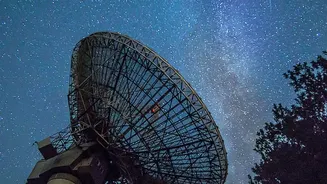
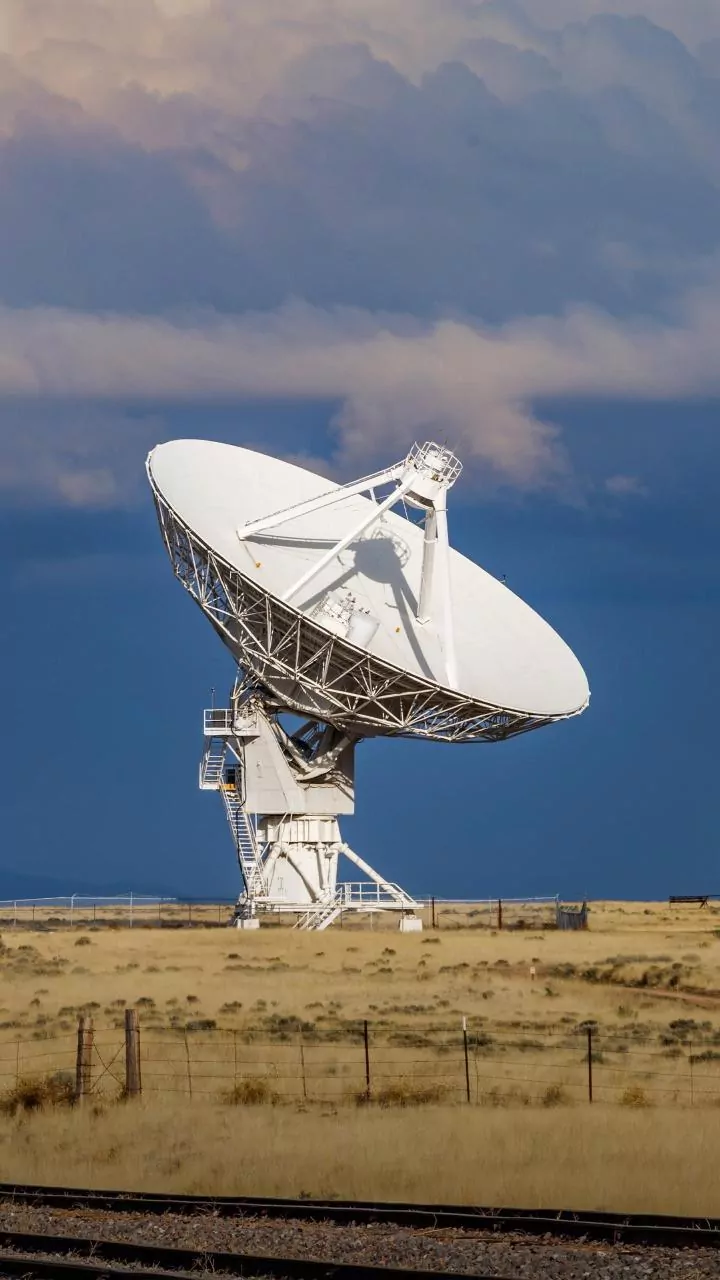
Enter the Canadian Hydrogen Intensity Mapping Experiment, or CHIME. Located in British Columbia, Canada, CHIME is not your typical telescope. Instead of a large, steerable dish, it consists of four stationary, 100-meter-long half-pipe-shaped reflectors. With no moving parts, it surveys the entire northern sky each day as the Earth rotates. Originally designed to map the most abundant element in the cosmos—hydrogen—CHIME has proven to be exceptionally adept at another task: detecting Fast Radio Bursts (FRBs), powerful but fleeting signals from distant galaxies. It's this unique capability, combined with its original mission, that has opened a new frontier in the study of dark energy.
Listening to Ancient Cosmic Echoes
The latest breakthrough from the CHIME collaboration isn't about FRBs, but about the very element it was named for: hydrogen. The team has successfully demonstrated it can detect the faint radio glow of neutral hydrogen gas from when the universe was just five billion years old. This is a landmark achievement because it was done using only CHIME's own data, a technique called auto-correlation, without needing to cross-reference with other expensive galaxy surveys. Neutral hydrogen emits a specific radio signal at a wavelength of 21 centimeters. As the universe expands, these ancient radio waves are stretched, or 'redshifted', to longer wavelengths by the time they reach Earth. CHIME is tuned to detect these stretched signals, effectively looking back in time.
Mapping the Universe to Measure Expansion
By detecting these ancient hydrogen signals, CHIME can create a massive 3D map showing how matter was distributed across space billions of years ago. This map isn't just a picture; it's a cosmic ruler. Imprinted on this large-scale structure are the faint patterns of acoustic waves from the very early universe. Scientists can use the size of these patterns as a 'standard ruler' to measure the universe's expansion rate at different points in its history. Tracking how this expansion has changed over cosmic time provides a direct test of dark energy models. While this initial detection doesn't yet solve the dark energy mystery, it proves that the technique works. It provides a powerful, independent, and more cost-effective way to probe the cosmic expansion history.
A New Window on the Cosmos
This new method provides a crucial alternative to traditional techniques like observing supernovae. By mapping the faint, 'fuzzy' radio emissions of hydrogen over vast volumes of space, CHIME can gather data more quickly and across a wider cosmic epoch than telescopes that must pinpoint individual galaxies. The research team is now analyzing seven years of collected data, hoping to extend their map back to when the universe was just three billion years old. This will provide an even more detailed look at how galaxies form and how the cosmic web of matter has evolved under the influence of dark energy. While significant challenges remain, such as filtering out radio noise from our own galaxy and human sources, the proof of concept is a game-changer. As one scientist put it, this has 'opened up a whole new window on the universe'.