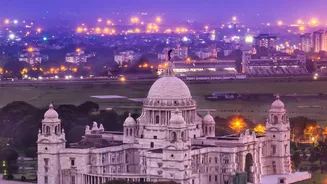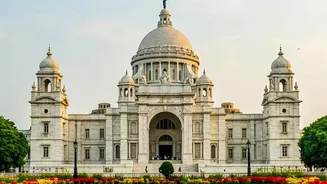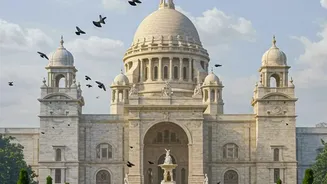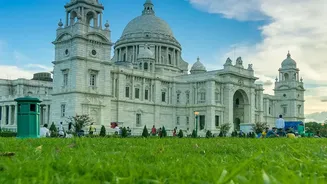






Victoria Memorial Hall
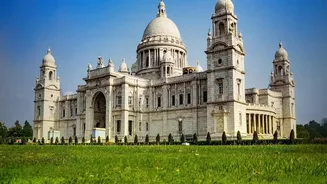
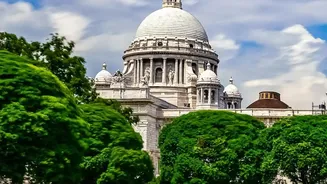
Often called the 'Taj of the Raj', the Victoria Memorial is Kolkata's most iconic landmark. Built between 1906 and 1921 from the same Makrana marble as the Taj Mahal, this sprawling monument was conceived by Lord Curzon to honour Queen Victoria. Its architectural
style is a grand fusion known as Indo-Saracenic, which blends British, Mughal, Venetian and Egyptian elements. Today, it serves as a museum with 25 galleries showcasing a vast collection of Raj-era paintings, artefacts, and manuscripts. Surrounded by 64 acres of lush gardens, it's a perfect spot to spend an afternoon soaking in history.
Writers' Building
With its striking Greco-Roman facade and distinctive red brick exterior, the Writers' Building is the very picture of colonial power. Originally constructed in 1777 to serve as the office for the junior clerks or 'writers' of the British East India Company, it eventually became the seat of the Bengal government. Located in B.B.D. Bagh (formerly Dalhousie Square), the building is famous for its 150-metre-long frontage and the statues of Greek gods lining its terrace. Although it recently underwent extensive restoration and government offices have shifted, it remains a potent symbol of Kolkata's administrative history.
St. Paul's Cathedral
An oasis of calm near the bustling Maidan, St. Paul's Cathedral is a pioneering example of 'Indo-Gothic' architecture. Completed in 1847, it was the first Anglican cathedral in Asia and was specifically designed to suit India's climate. Its most striking features include a towering spire, stunning stained-glass windows designed by Sir Edward Burne-Jones, and intricate frescoes. The cathedral's steeple has been rebuilt twice following earthquakes, a testament to the city's resolve to preserve its heritage. It's a must-visit for those interested in religious history and Gothic Revival architecture.
General Post Office (GPO)
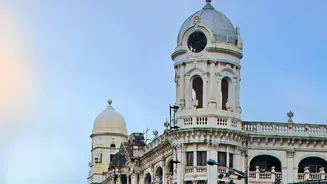
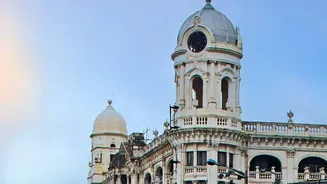
The General Post Office is not just a functional building but a magnificent architectural landmark. Designed by Walter B. Grenville and completed in 1868, its high, domed roof and towering Ionic-Corinthian pillars make it one of the most prominent structures in the B.B.D. Bagh area. It was built on the site of the first Fort William, and a brass plate on the eastern staircase marks the only remaining remnant of the old fort. Inside, a postal museum showcases a fascinating collection of stamps and artefacts. The GPO remains the central post office for the city, a living piece of history that continues its original purpose.
South Park Street Cemetery
For a truly unique and atmospheric experience, visit the South Park Street Cemetery. Established in 1767, it is one of the oldest non-church cemeteries in the world. This hauntingly beautiful site served as the burial ground for early European settlers. The eight-acre ground is filled with around 1,600 tombs that are architectural marvels in themselves, showcasing a mix of Gothic and Indo-Saracenic styles. You'll find elaborate mausoleums, pyramids, and sarcophagi dedicated to colonial-era figures, including Sir William Jones, founder of the Asiatic Society. It’s a quiet, poignant reminder of the lives that shaped early Calcutta.