



The Atmosphere as a Thick Filter
Think of the atmosphere as a blanket of air. When you look straight up, you’re looking through the thinnest part of it. But when you gaze towards the horizon, your line of sight travels through a much thicker, denser slice of that blanket. This lengthy
path has a dramatic effect on light travelling from space. The phenomenon, known as atmospheric extinction, is the reduction in brightness of celestial objects as their light passes through the air. Air molecules, dust, and water vapour scatter and absorb some of that light, meaning a star viewed near the horizon appears much dimmer than when it's high overhead. This effect is why professional observatories are built on high mountains—to get above as much of this light-distorting air as possible.
Why Sunsets and Moonrises Turn Red
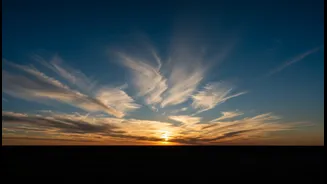
The thick atmosphere near the horizon doesn't just dim light; it also changes its colour. This is due to a process called Rayleigh scattering, the same effect that makes the sky blue. Sunlight is made of a spectrum of colours. Shorter wavelengths, like blue and violet, are scattered more easily by air molecules. When the Sun or Moon is low in the sky, its light travels so far through the atmosphere that most of the blue and green light is scattered away from our eyes. Only the longer wavelengths—the reds, oranges, and yellows—make it through directly, resulting in the spectacular colours we see at sunrise and sunset. Any extra particles in the air from dust or pollution can enhance this effect, making for an even redder view.
Bending Light and Distorting Shapes
The atmosphere doesn’t just filter light; it also bends it. This bending, called atmospheric refraction, occurs because the density of the air changes with altitude. This phenomenon makes celestial objects appear slightly higher above the horizon than they actually are. In fact, when you see the bottom edge of the Sun just touching the horizon at sunset, the entire star is already geometrically below it. Refraction effectively lifts it back into view, lengthening the day. This effect is also responsible for the flattened, squashed appearance of the low Sun or Moon. The light from the bottom limb of the disk travels through denser air and is bent more than the light from the top, causing a distorted, oval shape.
The Hunt for the Elusive Green Flash
One of the most sought-after atmospheric phenomena is the green flash. This is a brief burst of green light visible for just a second or two right at the top of the Sun as it sets or rises. It’s a direct result of refraction and scattering. As the atmosphere bends sunlight like a prism, it separates the colours slightly. For a fleeting moment, as the bulk of the Sun disappears, its upper rim can appear distinctly green because the green light is the last to be visible after red and orange have set and before blue is scattered away. Seeing one requires a very clear, unobstructed horizon, which is why they are most commonly reported over the ocean. The effect is enhanced by mirages caused by temperature layers in the air.
A Challenge for Stargazers
For amateur and professional astronomers, a clear horizon is essential for observing certain objects. Planets like Mercury are notoriously difficult to spot because they are always close to the Sun, meaning they are only visible low in the sky just before sunrise or after sunset. Any haze, pollution, or buildings on the horizon will completely obscure the view. The same is true for spotting very young crescent moons or observing planetary conjunctions that occur low in the west after sunset. The combination of dimming from extinction and blurring from turbulence makes viewing anything near the horizon a challenge, reinforcing why astronomers prize a clear, flat, and dark horizon for catching these fleeting celestial events.