



A Sweet Discovery in the Stars
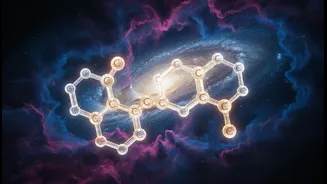
Astronomers have detected a specific type of sugar, known as erythrulose, floating in a vast cloud of gas and dust near the heart of the Milky Way. While this might sound strange, it’s not the first time organic molecules have been found in space. What
makes this discovery particularly exciting is that erythrulose is a true, four-carbon sugar. Previous detections involved simpler, sugar-like molecules, but finding a more complex one like this takes us a step up the ladder of chemical complexity. On Earth, erythrulose is a simple sugar found in things like red raspberries. In the cosmos, however, its presence suggests that the raw materials for life are not exclusive to planets but can form naturally in the harsh environment between stars.
How Did They Find It?
Detecting a single type of molecule 27,000 light-years away is an incredible feat of cosmic detective work. An international team of scientists, led by researchers in Spain, used powerful radio telescopes to peer into a dense molecular cloud named G+0.693-0.027. These clouds are stellar nurseries, where stars and planets are born. Every molecule vibrates and rotates at specific frequencies, creating a unique 'fingerprint' of light, or a spectrum. By capturing the faint radio waves coming from the cloud, astronomers matched the signal to the specific spectral fingerprint of erythrulose, which had been measured in a lab. The team identified 12 distinct spectral lines that confirmed the sugar's presence, making it one of the largest and most complex molecules of its kind found in the interstellar medium to date.
The Ingredients for Life
So, why is a space sugar so important? The answer lies in prebiotic chemistry—the chemical steps that occurred before life emerged. Sugars are fundamental to life as we know it. They form the structural backbone of RNA and DNA, the molecules that carry genetic instructions in all living things. For decades, a major puzzle for scientists has been how the first sugars formed on early Earth, as conditions on our young planet weren't ideal for producing them efficiently. The discovery of erythrulose in space provides a compelling answer. This sugar is a precursor, meaning it can easily change into other molecules that are essential for building nucleic acids like RNA. This supports a popular theory that the ingredients for life didn't have to be made on Earth from scratch. Instead, they could have been delivered.
From Cosmic Clouds to Young Planets
The existence of erythrulose in a star-forming cloud suggests that as new solar systems form, these essential sugars get incorporated into the asteroids and comets that are taking shape. For billions of years, these cosmic bodies have acted like a delivery service, crashing into young planets and seeding their surfaces with organic materials. Scientists estimate that during a period known as the Late Heavy Bombardment, millions of tonnes of erythrulose could have rained down on the early Earth. This cosmic delivery would have enriched the planet's 'prebiotic soup,' providing a ready supply of the crucial sugars needed to kick-start the first metabolic and genetic processes. This idea is bolstered by previous findings of other sugars, like ribose, in meteorites that have landed on Earth.
What This Means for the Search for Life
Ultimately, finding erythrulose in interstellar space is about more than just one molecule. It demonstrates that the chemical pathways leading to biologically relevant compounds are not a fluke unique to Earth; they are a universal process. If the building blocks of life are common throughout the galaxy, then the possibility of life emerging elsewhere becomes much more plausible. This discovery energizes the field of astrobiology, giving scientists new targets to search for. The next step is to look for even more complex sugars like ribose—the actual sugar in RNA—in these interstellar clouds. Each new molecule found strengthens the case that we are part of a chemically rich and creative universe, one where the seeds of life may be scattered among the stars.