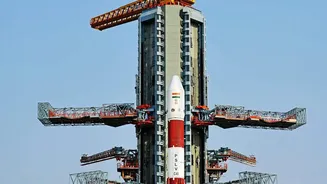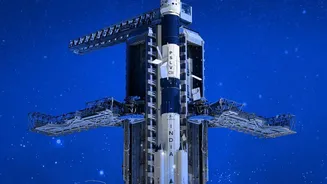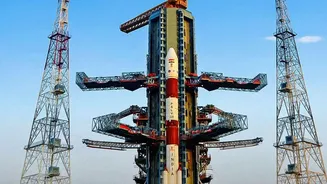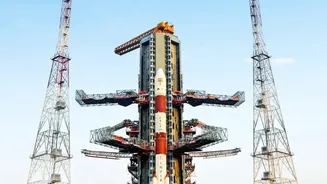







The fiery spectacle of a rocket launch is just the first, dramatic step. For ISRO's latest navigation satellite, the NVS-03, the real mission began moments after it separated from its launch vehicle, starting a complex, multi-day journey.
From Passenger to Pilot
On October 30,
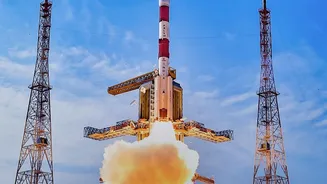
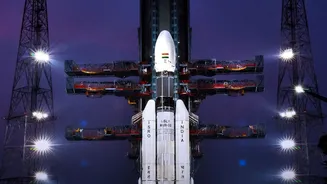
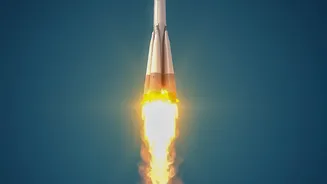
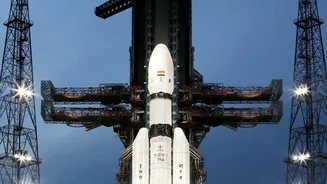
2026, ISRO's Geosynchronous Satellite Launch Vehicle (GSLV) successfully lifted off, carrying the crucial NVS-03 satellite. Its job was to ferry this 2,232 kg satellite into a specific, highly elliptical path around Earth known as a Geosynchronous Transfer Orbit (GTO). This initial orbit is like a cosmic slingshot, with a low point (perigee) relatively close to Earth and a high point (apogee) stretching out to nearly 36,000 kilometres. Once the rocket's work was done and the satellite was injected into this orbit, control was handed over to the engineers at ISRO's Master Control Facility (MCF) in Hassan, Karnataka. From this point on, the satellite had to navigate its own way to its final destination using its own onboard engine.
Climbing the Orbital Ladder
The primary task for the MCF team is to perform a series of meticulously planned orbit-raising manoeuvres. This process involves firing the satellite’s onboard Liquid Apogee Motor (LAM) at precise moments. These engine burns are conducted when the satellite is at its perigee, the point in its orbit closest to Earth. Each burn provides a powerful thrust that pushes the satellite, raising the altitude of its apogee, the farthest point of its orbit. The first of these manoeuvres for NVS-03 was successfully completed on October 31. Over several days, this step-by-step process gradually shapes the satellite's elliptical path, making it more and more circular and pushing it farther away from the planet.
Finding its Final Parking Spot
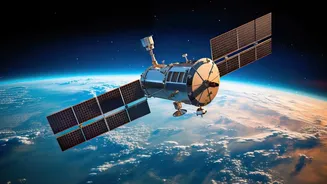
After several orbit-raising manoeuvres, the satellite reaches its target altitude of approximately 36,000 km. At this stage, a final engine burn is performed. This 'circularisation' manoeuvre adjusts the satellite's velocity to place it into a geosynchronous orbit. In this orbit, the satellite's orbital period matches Earth's rotation. Three of the NavIC constellation's satellites are in a geostationary orbit, meaning they appear to be fixed at the same point in the sky from the ground, while others are in an inclined geosynchronous orbit, allowing them to cover a wider area. This precise positioning is absolutely critical for a navigation satellite, as its stability directly impacts the accuracy of the signals it will eventually transmit.
Waking Up and Getting to Work
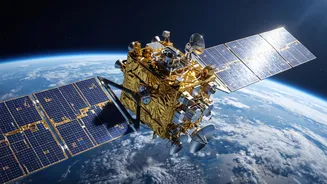
Once securely in its final orbit, the satellite begins its 'wake up' sequence. Solar panels, which were stowed during launch, are unfurled to provide power. Antennas and other instruments are deployed. Following this, a thorough checkout phase known as In-Orbit Testing (IOT) begins. Engineers on the ground meticulously test every system, from the crucial navigation payload to the onboard atomic clocks. NVS-03 carries an indigenously developed Rubidium atomic clock, a vital piece of technology for precise timing that is central to any navigation system. Only after all its systems are verified to be functioning perfectly is the satellite declared operational and integrated into the NavIC constellation.
Why NVS -03 is Crucial for NavIC
The successful addition of NVS -03 is a significant boost for India 's sovereign navigation system. NavIC , India 's answer to the US - owned GPS , provides vital positioning , navigation , and timing services for both civilian and strategic use. It reduces India 's dependence on foreign systems , a critical factor for national security. The second - generation NVS satellites are designed to augment and replace older satellites in the constellation , some of which had faced issues with their imported atomic clocks. Furthermore , NVS -03 transmits signals in the L1 frequency band , which is widely used by commercial GPS receivers. This move will make it much easier to integrate NavIC into everyday devices like smartphones and wearables , bringing India 's homegrown navigation system to the fingertips of millions.