







What is Opposition and Why Does It Matter?
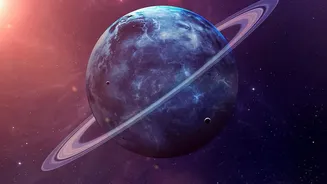
The best time to see an outer planet like Saturn is during an event called 'opposition'. On October 4, 2026, Earth passed directly between the Sun and Saturn. This celestial alignment does two things: first, it means Saturn is at its closest point to Earth for
the year, making it appear larger and brighter than usual. Second, it places the planet opposite the Sun in our sky. This means as the Sun sets in the west, Saturn rises in the east, staying visible all night long before setting in the west around sunrise. This opposition makes early October the prime season for Saturn-watching across India.
When and Where to Look From India
For observers in India, the timing is perfect for evening and late-night stargazing. Throughout early October, look towards the eastern sky shortly after sunset. In New Delhi, for example, Saturn rises around 6:11 PM, reaches its highest point in the sky just after midnight, and sets around 6:23 AM the next morning, offering a generous 12-hour viewing window, weather permitting. The planet will be the brightest, steadiest point of light in its patch of sky, located in the faint constellation of Cetus, the Whale. Because the surrounding stars are dim, Saturn’s steady, golden-yellow glow should be quite prominent.
Naked Eye, Binoculars, or Telescope?
The great news is you don't need any special equipment to see Saturn. It is bright enough to be easily visible to the naked eye, even from light-polluted cities, appearing as a bright, non-twinkling, creamy-white 'star'. Binoculars will enhance the view, making the planet look like a tiny, distinct oval rather than a point of light, but they won't resolve the rings. To see Saturn’s iconic rings, you’ll need a telescope. Even a small backyard telescope with a magnification of 50x to 100x is powerful enough to reveal the rings as separate from the planet’s disk. With a larger amateur telescope, you might even spot the Cassini Division, the dark gap separating the main rings.
Tips for Urban Stargazers
Viewing from a bustling Indian city presents the challenge of light pollution. However, Saturn is bright enough to cut through a surprising amount of urban glow. To improve your chances, find a location away from the direct glare of streetlights, such as a local park, a rooftop, or a balcony with a clear view of the eastern horizon. Another key tip is to wait until the planet has climbed higher into the sky, typically a few hours after sunset. Viewing an object when it's higher reduces the amount of Earth's turbulent atmosphere you have to look through, resulting in a steadier, clearer image. Also, allow your eyes about 20 minutes to adjust to the darkness for the best experience.
Let an App Be Your Guide
If you're unsure where to point your gaze, your smartphone can be an invaluable co-pilot. Modern stargazing apps use your phone's GPS and compass to create a real-time map of the sky. Simply point your device towards the sky, and the app will identify planets, stars, and constellations for you. Popular and user-friendly options available in India include Stellarium, SkyView, and Star Tracker. Many of these apps have a search function; just type in 'Saturn,' and an arrow will guide you directly to its current position. Some apps like Bhagol even offer a sky map with an interface in Hindi.