






A Roar of Progress
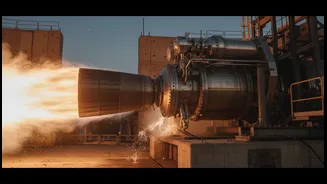
On July 3, the Indian Space Research Organisation (ISRO) successfully conducted the first ground test of a new solid rocket motor. This was a 'static test', meaning the powerful engine was fired while firmly bolted to the ground, allowing engineers to measure
its performance without an actual launch. The test, which took place at ISRO's main spaceport in Sriharikota, was a complete success, with the motor performing exactly as predicted and meeting all crucial performance targets. While it didn't leave the ground, this test represents a significant leap forward for the nation's most ambitious space project: Gaganyaan, the mission to send Indian astronauts into orbit.
Introducing the SOLVE Rocket
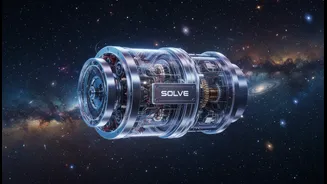
The motor tested is the heart of a new vehicle called SOLVE, which stands for Sub-Orbital Launch Vehicle for Experiments. Unlike its famous cousins, the PSLV and GSLV which are designed to place satellites into orbit, SOLVE has a different, highly specialized purpose. It’s not meant for deep space journeys but for short, controlled flights up and back down. Think of it as a dedicated test platform, a crucial tool built specifically to validate the systems that will ensure the safety of the Gaganyaan crew. Its entire reason for being is to make sure one of the most dangerous parts of space travel—coming back home—goes perfectly.
The Critical Mission of a Safe Return
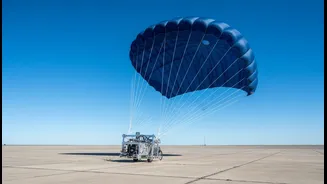
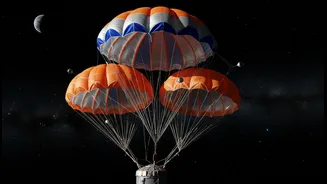
SOLVE's primary job is to test the complex parachute system for the Gaganyaan crew module. During future test missions, the SOLVE rocket will carry a crew module to an altitude between 10 and 17 kilometres. Once it reaches the target height, the module will separate and begin its descent. This will trigger a precisely planned sequence where a series of 10 different parachutes deploy to steadily slow the capsule down before it safely splashes into the sea. Safely managing the violent re-entry and descent is one of the biggest challenges in human spaceflight, and SOLVE is designed to let ISRO rehearse this critical sequence again and again under various conditions.
Built on a Legacy of Success
Rather than starting from scratch, ISRO engineers have cleverly adapted existing, proven technology. The solid motor for SOLVE is derived from the strap-on boosters used on India's workhorse rocket, the Polar Satellite Launch Vehicle (PSLV). However, it has been significantly modified for its new role. These changes include using a slower-burning propellant to allow for a more controlled flight path and adding a sophisticated secondary injection thrust vector control system, which acts like a smart rudder to help steer the rocket with high precision. These modifications turn a powerful booster into a finely-tuned instrument perfect for conducting delicate safety experiments.
Making Astronaut Safety Tangible
This successful test is more than just a single achievement; it validates the creation of a flexible and reliable testbed. Having a dedicated vehicle like SOLVE gives ISRO the freedom to conduct numerous test missions, simulating a wide range of flight conditions that the Gaganyaan crew might one day face. It allows engineers to gather immense amounts of data and be absolutely certain that the parachute systems will work flawlessly before any human is on board. This moves the preparation from computer simulations and theoretical models into the real world of hardware, fire, and force. It makes the abstract concept of safety a tangible, tested reality.