







A Mission of Galactic Proportions
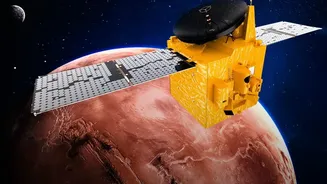
The Emirates Mission to the Asteroid Belt (EMA) is a landmark project by the UAE Space Agency. Scheduled to launch in March 2028, a spacecraft named the MBR Explorer will travel approximately 5 billion kilometres through the main asteroid belt located
between Mars and Jupiter. Over its 13-year journey, the explorer will conduct flybys of six asteroids before its grand finale: a rendezvous with a seventh, the mysteriously red-hued asteroid known as 269 Justitia, in 2036. The mission aims to gather crucial data on the origins of our solar system, particularly focusing on the presence of water and the building blocks of life. It represents a monumental undertaking in deep-space exploration, and a Bengaluru-based startup is playing a pivotal role in its success.
The Indian Engine Powering the Journey
At the heart of the MBR Explorer's ability to navigate the vastness of space is technology from Bellatrix Aerospace. This Indian space-tech startup was selected to develop and supply the spacecraft's propulsion system. Specifically, Bellatrix is providing eight of its patented Hall-effect thrusters. These thrusters are a form of electric propulsion, which is essential for long-duration missions where fuel efficiency and precise control are paramount. This isn't just a minor component; the propulsion system is the engine that allows the spacecraft to adjust its trajectory, perform complex gravity-assist manoeuvres around planets like Venus and Earth, and ultimately arrive at its distant targets. The selection of an Indian firm for such a critical subsystem is a massive vote of confidence in the country's burgeoning private space sector.
What Are Hall Thrusters?
Unlike the powerful chemical rockets that blast a spacecraft off Earth, Hall thrusters operate on a different principle. They are a type of electric propulsion system that uses electricity to create and accelerate a stream of charged ions—in this case, from xenon gas—to generate thrust. The thrust is gentle but incredibly efficient, often described as the force equivalent to the weight of a sheet of paper. While that might not sound like much, this constant, steady push applied over months and years allows a spacecraft to achieve very high speeds with a fraction of the propellant required by chemical engines. For a mission like the MBR Explorer, which needs to travel billions of kilometres and make multiple precise orbital adjustments, the high fuel efficiency of Hall thrusters is a game-changer, making the mission feasible.
A Landmark for Indian Space-Tech
For decades, India's space ambitions were driven almost exclusively by the Indian Space Research Organisation (ISRO). However, recent policy reforms have opened the door for private companies to innovate and compete on a global scale. Bellatrix Aerospace's contract with the UAE Space Agency is one of the most significant achievements to emerge from this new ecosystem. It demonstrates that Indian companies are not just manufacturing components for domestic needs but are developing cutting-edge technologies sought after for premier international deep-space missions. This success helps establish India as a credible, high-tech player in the global space supply chain, moving beyond its reputation as just a low-cost launch provider. It signals a new era where Indian startups are becoming integral partners in the next generation of space exploration.
From Bengaluru to the Asteroid Belt
Founded in 2015, Bellatrix Aerospace has steadily built a reputation for its innovative propulsion systems. The company, which was incubated at the prestigious Indian Institute of Science in Bengaluru, has worked on various thruster technologies, including a unique microwave electrothermal thruster and eco-friendly chemical propellants. Their expertise in Hall thrusters, which were successfully tested in orbit on an ISRO mission, ultimately paved the way for this international collaboration. The journey from a promising startup to a key supplier for an interplanetary mission highlights the rapid maturation of India's private space industry. The government's IN-SPACe initiative, designed to facilitate private sector participation, has been crucial in helping companies like Bellatrix access resources and opportunities.