


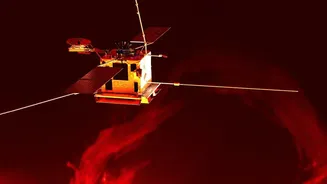


The Sun's Fiery Temper
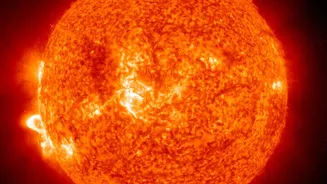
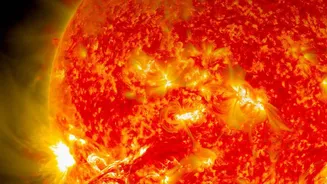
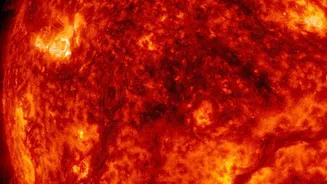
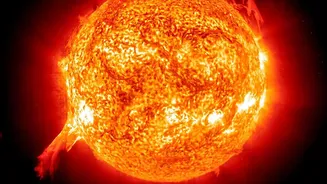
The Sun, our life-giving star, has a volatile side. It frequently unleashes solar flares, which are immense bursts of radiation. These are often followed by Coronal Mass Ejections (CMEs), which are colossal clouds of magnetised plasma and particles hurled
into space. While the light from a flare reaches Earth in about eight minutes, the particles from a CME travel slower, taking one to several days to arrive. When aimed at Earth, these solar storms can wreak havoc. They pose a significant threat to our technologically dependent world, capable of disrupting satellite communications, damaging power grids, interfering with GPS navigation, and endangering astronauts in orbit.
A Prime Viewing Spot
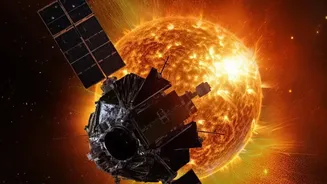
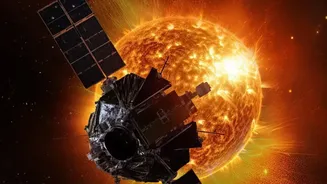
To effectively monitor this solar activity, you need an uninterrupted view. That’s why ISRO strategically placed Aditya-L1 in a halo orbit around the Sun-Earth Lagrange Point 1, or L1. Located about 1.5 million kilometres from Earth, this is a point in space where the gravitational forces of the Sun and Earth are balanced, allowing the spacecraft to stay in a stable position relative to both. This unique vantage point provides Aditya-L1 with a continuous, 24/7 view of the Sun, free from any eclipses or occultations caused by the Earth or Moon. It also allows the observatory's instruments to study solar radiation and particles before they interact with Earth’s magnetic field.
A Suite of Seven Sentinels
Aditya-L1 is equipped with seven sophisticated, indigenously developed payloads designed to observe the Sun in different ways. Four of these are remote-sensing instruments that look directly at the Sun, while three are in-situ instruments that measure the space environment at the L1 point. For tracking high-energy flares, two instruments are particularly crucial: the High Energy L1 Orbiting X-ray Spectrometer (HEL1OS) and the Solar Ultraviolet Imaging Telescope (SUIT). HEL1OS is designed to detect the hard X-rays produced during the very first, impulsive moments of a solar flare. Meanwhile, SUIT captures images of the Sun's lower atmosphere in near-ultraviolet light, a spectrum mostly invisible from Earth.
Catching the Flicker Before the Flame
The headline claim isn't just about watching a flare as it happens; it's about finding the clues before a major eruption. Recent studies using data from Aditya-L1 have revealed a groundbreaking discovery. By using its SUIT, SoLEXS, and HEL1OS instruments in tandem, scientists have identified small, short-lived 'brightenings' in the Sun's atmosphere. These tiny flickers appear hours before a major flare and are clustered in the exact location where the eruption will later occur. These events are believed to be small-scale releases of magnetic energy, which progressively destabilise the area and act as a precursor to the main event. Detecting these pre-flare activities is a major leap forward, transforming solar forecasting from a reactive analysis into a more predictive science.
From Data to Early Warning
When Aditya-L1’s instruments like HEL1OS detect the initial X-ray burst of a flare, that information travels to Earth at the speed of light, serving as the first alarm. Simultaneously, the Visible Emission Line Coronagraph (VELC), the primary payload, can observe the CME as it leaves the Sun. An onboard algorithm helps VELC automatically detect CMEs, a feature not previously used in major solar missions. This data is sent back to ISRO's Indian Space Science Data Centre (ISSDC). Scientists analyse this information to predict the trajectory and potential impact of the incoming solar storm. This gives authorities and operators of critical infrastructure anywhere from several hours to a couple of days of advance warning to take protective measures, such as powering down sensitive satellite components or preparing power grids for potential surges.