



A Bizarre Calendar
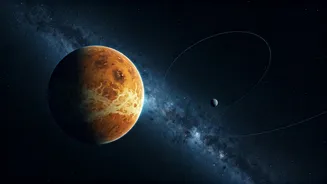
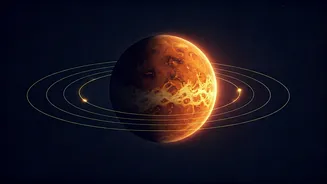
Let’s start with the hard numbers, which sound like they belong in a science fiction novel. It takes Venus about 225 Earth days to complete one full orbit around the Sun. This is its year. Simple enough. However, it takes the planet a staggering 243 Earth days to complete just
one rotation on its axis. This is its sidereal day. So, yes, the headline is true: a single Venusian day is 18 Earth days longer than a Venusian year. If you were celebrating your 'birthday' on Venus (one trip around the Sun), you wouldn’t have even completed a single 'day' yet. This fact makes Venus a true standout in our solar system, an oddball sibling to Earth with a completely alien sense of time.
What 'Day' Are We Talking About?
The confusion deepens, and gets more interesting, when we clarify what we mean by 'day'. The 243-day figure is a sidereal day—the time it takes for the planet to spin 360 degrees on its axis relative to the distant stars. But what we experience as a day on Earth is a solar day—the time it takes for the Sun to return to the same position in the sky (e.g., from one noon to the next). On Earth, these two are very close, with a solar day being 24 hours and a sidereal day being about 23 hours and 56 minutes. On Venus, the difference is massive. Because of its unique spin, a solar day on Venus is 'only' about 117 Earth days long. So you’d wait nearly four Earth months for the sun to rise again, but it’s still much shorter than the planet's full rotation period.
The Secret Is a Backward Spin
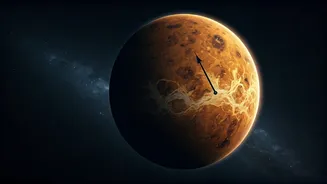
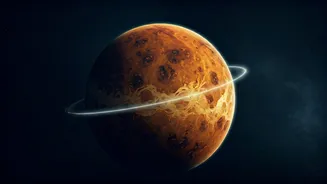
The key to this cosmic paradox is Venus's retrograde rotation. Unlike Earth and most other planets in our solar system, which spin counter-clockwise on their axes, Venus spins clockwise. It's essentially rotating backwards. Imagine you're on a very slow merry-go-round that is itself orbiting a central point. If you walk slowly in the opposite direction of the merry-go-round's spin, you'll get back to your starting point (relative to the outside world) much faster. This is what happens on Venus. The planet’s slow, backward rotation works against its orbit around the Sun. This opposition shortens the time between sunrises, creating a solar day (117 Earth days) that is dramatically different from its sidereal day (243 Earth days).
What Would This Cycle Feel Like?
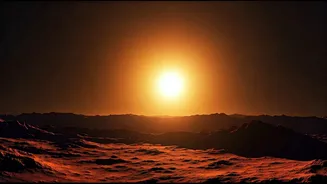
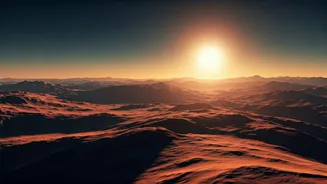
Putting aside the crushing pressure, surface temperatures that can melt lead, and sulfuric acid clouds, what would this time cycle feel like? For starters, the Sun would rise in the west and set in the east. Each period of daylight would last for nearly two Earth months, followed by an equally long night. The transition from day to night wouldn't be a swift sunset but a painfully slow descent of the Sun over many, many hours. The sky would be a perpetual, hazy orange-yellow due to the thick atmosphere scattering sunlight. This extreme environment, governed by a time cycle completely foreign to us, is a powerful reminder of how diverse planetary conditions can be.
Why Is Venus So Strange?
Scientists are not entirely sure why Venus spins so slowly and backwards. The leading theory is that it was struck by a massive asteroid or planetesimal early in its history, which either dramatically slowed its original rotation or knocked it upside down, effectively reversing its spin. Another compelling hypothesis involves its incredibly thick atmosphere—90 times denser than Earth's. Over billions of years, strong atmospheric tides, created by solar heating, could have acted as a brake, slowing the planet’s spin to its current crawl. It’s also possible a combination of these and other factors contributed to Venus's uniqueness. Missions like NASA’s DAVINCI and VERITAS are planned to gather more data and help solve this long-standing mystery.