


A Gift From a Famous Comet
The story of the Orionids begins with one of the most famous objects in our solar system: Halley's Comet. This massive ball of ice, rock, and dust orbits the sun roughly every 76 years. Each time it swings through the inner solar system, the sun's intense
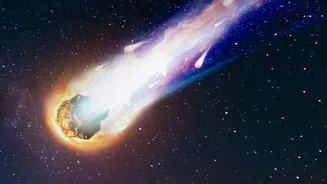
heat causes it to shed a trail of dusty, icy debris. Think of it like a messy traveler leaving a trail of cosmic breadcrumbs along its orbital path. Halley's Comet last visited our neighbourhood in 1986 and isn't due back until 2061, but the stream of particles it has left behind over centuries remains. It is this ancient debris field that causes the Orionid meteor shower.
Why October? Earth's Cosmic Intersection
The reason this shower happens every October is a matter of orbital mechanics. Just as a train runs on a fixed track, Earth follows a predictable path around the sun each year. This orbit happens to intersect the debris trail of Halley's Comet twice. The first intersection occurs in May, causing the Eta Aquariid meteor shower. The second happens in late October, when Earth ploughs through a different part of the same vast debris stream, giving us the Orionids. So, every October, our planet's journey brings us to the right place at the right time to collide with these leftover particles from Halley's Comet.
From Dust to Dazzling Light
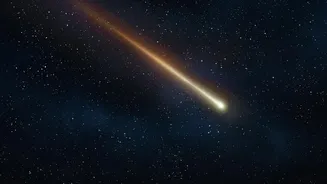
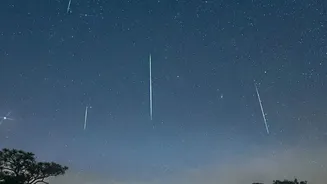
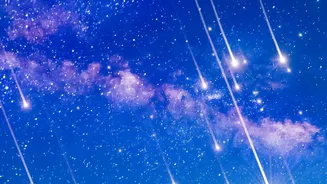
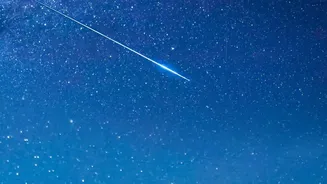
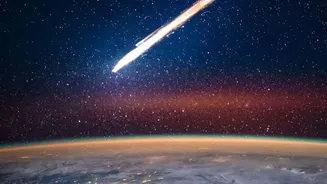
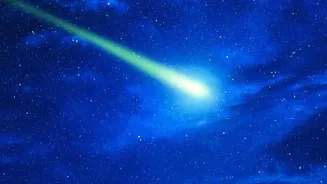
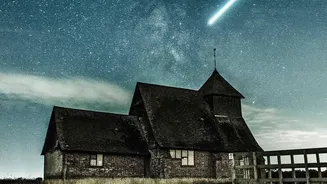
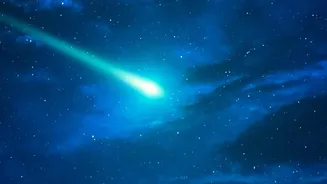
The 'shooting stars' we see are not actually stars at all. They are tiny pieces of cometary debris, often no larger than a grain of sand, entering Earth's atmosphere at incredible speeds. Orionid particles slam into our atmosphere at about 66 kilometres per second. At this blistering pace, friction with air molecules heats the particles to incandescence, causing them to burn up and create the fiery streaks we call meteors. Because of their high speed, Orionid meteors are known for their brightness and can sometimes leave behind glowing trails, or 'trains', of incandescent debris that can linger for several seconds. Particularly bright ones are known as fireballs.
The Hunter's Radiant Glow
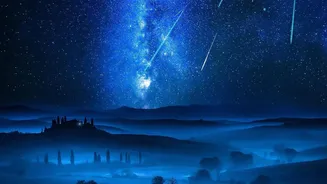
The shower gets its name from the constellation Orion, the Hunter. To a person watching from Earth, the meteors appear to originate from a single point in the sky, known as the radiant. For the Orionids, this radiant point is located near Orion's bright star, Betelgeuse. This doesn't mean the meteors come from the constellation itself; it's simply a line-of-sight effect, similar to how parallel railway tracks appear to converge in the distance. You don't need to stare directly at Orion to see the show, as the meteors will streak across the entire sky. In fact, looking about 45 degrees away from the radiant can often provide a better view of meteors with longer trails.
How to Watch the 2026 Show
The Orionids are active from early October to early November, but the best time to watch in 2026 will be during the peak on the nights of October 21 and 22. Observers can expect to see between 15 and 25 meteors per hour under ideal conditions. The best viewing window is in the pre-dawn hours, after midnight. This year, a bright waxing gibbous moon will be in the sky, which could wash out some of the fainter meteors. However, the moon is expected to set around 3 a.m. local time, leaving a couple of dark hours before dawn for prime viewing. For the best experience, find a location far from city lights, lie back, and give your eyes about 30 minutes to fully adjust to the darkness. No special equipment is needed—just patience and a clear sky.