






Why Titan Is an Explorer's Utopia
Titan is an object of immense scientific fascination. It is the only moon in our solar system with a dense atmosphere, which is four times denser than Earth's. This thick, nitrogen-rich atmosphere supports a weather system akin to our own, but with a crucial
difference: it rains liquid methane and ethane, not water. These hydrocarbons form rivers, lakes, and seas, sculpting a surface that looks surprisingly familiar yet is fundamentally alien. Beneath its icy crust, Titan is believed to harbor a vast liquid water ocean. This combination of complex organic compounds on the surface and a subsurface water ocean makes it a prime target for astrobiology—the study of the origins and potential for life in the universe. Scientists believe Titan's environment may resemble a frozen version of early Earth, providing a unique laboratory for studying how far prebiotic chemistry—the chemical steps before life—can progress.
A Revolutionary Explorer Takes Flight
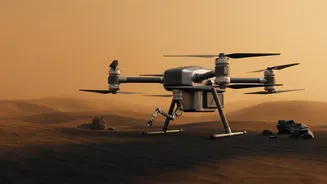
To navigate this unique world, NASA is sending an octocopter—a drone with eight rotors. Called Dragonfly, the craft is roughly the size of a small car and weighs about 450 kilograms. Its design is a game-changer for planetary exploration. While rovers are limited to the terrain they can slowly crawl over, Dragonfly will take advantage of Titan's low gravity and thick, calm atmosphere to fly between dozens of scientifically interesting locations. Unable to use solar power under Titan's hazy skies, it will be powered by a Multi-Mission Radioisotope Thermoelectric Generator (MMRTG), the same reliable nuclear power source used by the Curiosity and Perseverance rovers on Mars. This allows it to operate in the extreme cold, where temperatures average a frigid -179 degrees Celsius.
A Flying Geochemical Laboratory
Dragonfly is equipped with a sophisticated suite of instruments designed to taste, smell, and see the world around it. Its primary tool is the Dragonfly Mass Spectrometer (DraMS), which will analyze surface and atmospheric samples to identify complex organic molecules, especially those relevant to life. To collect these samples, the DrACO (Drill for Acquisition of Complex Organics) system will drill into the surface and pneumatically transfer the material to the spectrometer. The Dragonfly Gamma-Ray and Neutron Spectrometer (DraGNS) will measure the composition of the ground beneath the lander, helping scientists understand the distribution of water ice and other materials. Meanwhile, the DragonCam camera suite will provide panoramic images of the landscape, and a meteorology package will monitor atmospheric conditions like wind, pressure, and temperature.
A Mission of Strategic Hops
The mission, scheduled for launch in July 2028, will arrive at Titan in 2034. Its planned landing site is in a dry, equatorial region of dunes called Ahmakiq Undae, near the 80-kilometer-wide Selk impact crater. This location is compelling because the energy from the impact that created the crater is thought to have melted local water ice, allowing it to mix with the abundant surface organics for a time. From its landing spot, Dragonfly will perform a series of 'leapfrog' flights. It will spend most of its time on the ground conducting experiments—about one full Titan day, which is 16 Earth days. Then, it will fly for up to 8 kilometers in a single hop, a distance greater than any rover has traveled in a day, to a new site. Over its multi-year primary mission, it is expected to travel more than 175 kilometers, exploring diverse geological settings.