



A Library Built From Snow
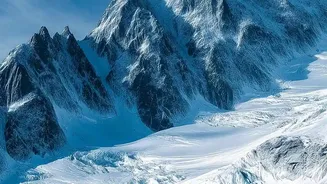
Imagine a place so cold that snow never fully melts. In polar regions, each year's snowfall gently settles on top of the last, forming distinct annual layers. Over centuries and millennia, the immense weight of the accumulating snow compresses the deeper
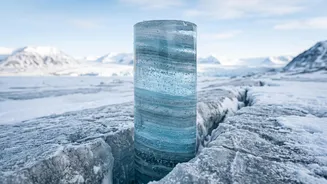
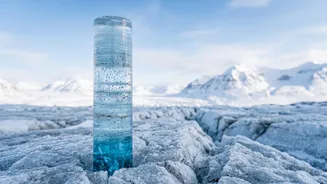
layers, transforming them from light, fluffy snow into dense, solid ice. Much like the rings of a tree, these layers create a vertical timeline. The ice at the top is recent, while the ice at the very bottom can be astonishingly old. Scientists can drill down and extract long cylinders of ice, known as ice cores, which can stretch over three kilometres in length and represent up to 800,000 years of Earth's history in a continuous record. Some research projects have even found ice dating back millions of years.
Tiny Bubbles of Ancient Air
The most remarkable feature of these ice cores is what’s trapped inside: tiny bubbles of air. As snow piles up, air fills the spaces between the individual snowflakes. When the snow is compressed into ice, these pockets of air are sealed off, creating perfect, miniature samples of Earth's past atmosphere. These bubbles are literal time capsules, preserving the exact composition of the air from the moment they were trapped. By carefully extracting and analysing this ancient air, scientists can directly measure the concentration of crucial greenhouse gases like carbon dioxide (CO2) and methane. This process happens in a vacuum to ensure the ancient air isn't contaminated by our modern atmosphere.
Decoding the Chemical Clues
Beyond the air bubbles, the ice itself is a rich source of information. The water molecules (H2O) contain different types of oxygen atoms, known as isotopes. The ratio of heavy to light oxygen isotopes in the ice acts as a natural thermometer, revealing the temperature at the time the snow fell. Colder temperatures, for instance, lead to lower concentrations of heavy oxygen in the snow that reaches the poles. Furthermore, ice cores contain traces of other substances that were in the atmosphere. Layers of dust can indicate arid, windy periods, while ash from volcanic eruptions leaves a distinct chemical signature that can be seen in cores across the globe, helping scientists synchronise their timelines. Other trapped particles can shed light on past forest fires, sea ice extent, and even solar activity.
How Scientists Read the Layers
Dating an ice core is a meticulous process. For the upper, more recent layers, scientists can often count the annual bands, which may be visible due to seasonal differences in dust or chemistry. This is similar to counting tree rings. As the ice gets deeper, however, these layers become compressed and harder to distinguish. To date the older ice, researchers rely on a combination of methods. They use mathematical models of how ice flows and compacts over time. They also look for those global markers, like volcanic ash layers, which correspond to known historical events and can be verified by other geological records. Radiometric dating of elements like carbon or uranium found in the ice provides another layer of verification for building a robust timeline.
Why These Icy Records Matter
By piecing together all this evidence—gas concentrations, temperature proxies, and trapped particles—scientists can reconstruct a detailed history of Earth’s climate. These ice cores have shown that for hundreds of thousands of years, CO2 levels in the atmosphere naturally cycled between about 180 parts per million (ppm) during cold ice ages and 280 ppm during warmer periods. The data also reveals that today's atmospheric CO2 concentration, which is now well over 400 ppm, is far higher than anything seen in the last 800,000 years. The speed of this recent increase, driven by human activity since the Industrial Revolution, is also unprecedented in the long-term record. This long-term context is critical; it proves that the changes we are witnessing today are not part of a natural cycle, but an abrupt shift in our planet's climate system.