



An Inhospitable Water World
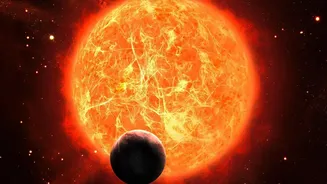
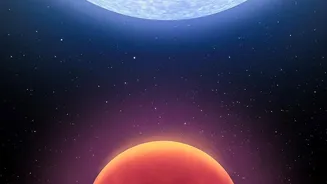
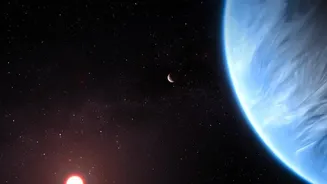
Meet WASP-18 b, an exoplanet that defies easy categorization. Located about 400 light-years from Earth, this behemoth is classified as an 'ultra-hot Jupiter'. It's ten times more massive than our own solar system's Jupiter but orbits its star in less
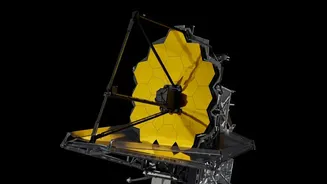
than 23 hours. This incredibly tight orbit means the planet is tidally locked, with one side perpetually facing its star in a permanent state of day. Temperatures on this dayside reach a staggering 2,700 degrees Celsius, hot enough to vaporize rock. For years, scientists have studied this extreme world, but the James Webb Space Telescope (JWST) has provided the most detailed look yet, revealing a fascinating and violent atmospheric story.
Webb’s Unprecedented Gaze
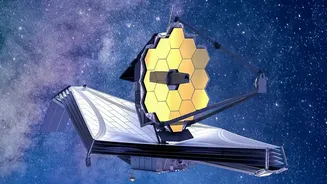
So, how can scientists study the atmosphere of a planet hundreds of light-years away? The magic lies in a technique called spectroscopy. When WASP-18 b passes in front of or behind its star, the JWST’s sensitive instruments can analyze the light. By measuring the combined light of the star and planet, and then just the star's light as the planet is eclipsed, astronomers can subtract one from the other to isolate the planet's own atmospheric signature. This signature contains chemical fingerprints—subtle dips and peaks in the light spectrum that correspond to specific molecules. Previous observations had struggled to get a clear picture, but Webb's power has finally allowed scientists to read these faint signals with astonishing precision.
A Tale of Broken Molecules
The latest analysis from Webb confirmed the presence of water vapor in WASP-18 b's atmosphere. But here’s the twist: the planet is so intensely hot that it should be tearing most water molecules apart into their constituent hydrogen and oxygen atoms. The fact that Webb detected any water signature at all is a testament to its incredible sensitivity. More importantly, the data allowed scientists to create a temperature map of the atmosphere, which revealed something remarkable. In the very hottest parts of the planet's dayside, the water signature vanishes, consistent with theories that the molecules are being dissociated by the extreme heat and radiation. For the first time, scientists are not just inferring this process; they are observing it happening across different zones of a single alien atmosphere.
Why This Discovery Matters
Observing water get destroyed on a distant planet might seem like a purely academic exercise, but it has profound implications. This discovery provides a real-world laboratory for testing atmospheric models under conditions non-existent in our solar system. By seeing which molecules survive and at what temperatures and altitudes, scientists can refine their understanding of planetary chemistry. This helps them better predict what they might find on other, potentially more hospitable worlds. Ultimately, understanding why a planet like WASP-18 b is so inhospitable is a crucial step in identifying the characteristics of planets that could support life. It's a reminder that finding water is just the first step; a planet also needs the right conditions to hold onto it.