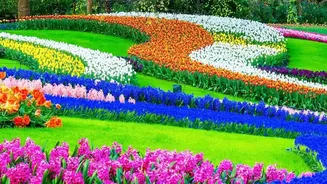






From the deep red of a rose to the sunny yellow of a marigold, the vibrant colours of flowers are a feast for the eyes. But have you ever wondered what’s behind this spectacular display? It’s not magic, but a fascinating blend of chemistry and biology.
Meet the Pigments
The secret to a flower's colour lies in natural chemical compounds called pigments. These molecules are responsible for absorbing certain wavelengths of light and reflecting others. The colour we see is the light they reflect. A flower's genetic makeup determines which pigments it produces and in what quantity. While there are thousands of individual compounds, they mostly fall into a few major groups, with two doing most of the heavy lifting: anthocyanins and carotenoids. These are often produced in combination to create an even wider spectrum of shades.
Anthocyanins: The Reds, Purples, and Blues
Anthocyanins are the most common and versatile pigments in the flower world, responsible for most of the red, pink, purple, and blue hues we see. These water-soluble pigments are stored in the fluid-filled sacs within plant cells, known as vacuoles. The exact colour an anthocyanin produces isn't just about the pigment itself; it's highly sensitive to its environment. The acidity (pH) of the cell sap can cause dramatic shifts: acidic conditions tend to produce reds, neutral pH leads to purples, and alkaline environments create blues. This is why a single type of pigment can yield a whole rainbow of possibilities across different plant species.
Carotenoids: The Yellows and Oranges
If you love the cheerful yellows of sunflowers or the bright oranges of marigolds, you have carotenoids to thank. Unlike anthocyanins, these pigments are fat-soluble and are housed in different cell parts called plastids. They are generally more stable and their colour is less affected by pH changes. Carotenoids are responsible for the yellow, orange, and some red colours in many plants. Besides making flowers look beautiful, these compounds play a vital role in photosynthesis and are also important for human nutrition as some are precursors to vitamin A.
The Special Case of White and Green
What about white flowers, like jasmine or lilies? You might think they have a white pigment, but that's usually not the case. White is typically the result of an absence of other pigments. Instead of containing pigments that absorb light, the petals of white flowers have microscopic air spaces and cell structures that scatter all wavelengths of visible light, causing them to appear white to our eyes. Green flowers, though less common, get their colour from chlorophyll, the same pigment that makes leaves green and is essential for photosynthesis.
More Than Just Pigments
While genetics and pigments lay the foundation, other factors can influence a flower's final shade. The most famous example is the hydrangea, whose flowers can turn from pink to blue depending on the soil. This change is caused by the availability of aluminium ions in the soil, which the plant can absorb more easily in acidic conditions, leading to blue flowers. In alkaline soil, aluminium is 'locked up', and the flowers remain pink. Temperature and the amount of light a plant receives can also affect pigment production, sometimes resulting in more intense colours.
A Colourful Invitation
Ultimately, a flower's colour serves a crucial evolutionary purpose: reproduction. These vibrant displays are not meant for us, but are elaborate advertisements for pollinators like bees, butterflies, and birds. Different pollinators are attracted to different colours. For instance, bees are drawn to blue and yellow flowers and can even see patterns in ultraviolet light that are invisible to humans. Birds, on the other hand, often prefer bright reds and oranges. By evolving colours that appeal to specific local pollinators, flowers ensure their survival and the continuation of their species.