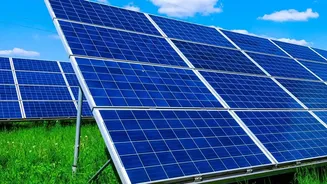








What Exactly Are Perovskite Panels?
Think of solar panels today, and you're likely picturing rigid, blue or black silicon-based modules. For decades, silicon has been the undisputed king of solar energy. Perovskites represent a new challenger with a different approach. A perovskite is a material
with a specific crystal structure that is incredibly good at absorbing sunlight. Unlike silicon, which requires high-temperature, energy-intensive manufacturing, perovskite materials can be made into thin, lightweight, and even flexible layers using simpler, low-cost methods akin to printing. This potential for cheaper production has made them one of the most exciting areas of renewable energy research. The core idea is to create solar cells that are not only powerful but also more accessible and versatile than their traditional counterparts.
The Efficiency Breakthroughs Explained
The single biggest story in solar technology right now is the stunning rise in perovskite efficiency. A panel's efficiency is the measure of how much sunlight it converts into usable electricity. While typical commercial silicon panels operate in the 20-24% efficiency range, scientists have been pushing perovskites to new heights in the lab. The most significant development is the 'tandem' solar cell, which stacks a thin perovskite layer on top of a traditional silicon cell. This combination is a powerhouse. The perovskite layer captures high-energy light (like blues and greens), while the silicon layer below absorbs the remaining lower-energy light. Together, they harvest more of the sun's spectrum. As a result, lab-tested tandem cells have shattered records, achieving efficiencies of over 34%, surpassing the theoretical limit of silicon-only cells. These are not just small improvements; they represent a fundamental leap in solar power potential.
How Higher Efficiency Lowers Your Bills
The link between panel efficiency and household savings is direct. Higher efficiency means you can generate more electricity from a smaller rooftop area. If a panel is 30% more efficient, you need fewer panels to produce the same amount of power, which reduces the overall cost of materials, mounting hardware, and installation. This is especially crucial in dense urban areas where rooftop space is limited. Furthermore, generating more power from each panel over its lifespan leads to a lower Levelized Cost of Electricity (LCOE) — the total cost per unit of energy produced. Research suggests that once commercially mature, a highly efficient perovskite tandem panel could produce electricity at a similar or lower price than a standard silicon panel, even if the initial purchase price is higher. Ultimately, this means a faster return on your investment and more significant savings on your monthly power bills over the 25-year life of the system.
Challenges and the Timeline for India
Despite the exciting lab results, perovskite panels are not yet available for mass-market residential installation. The biggest historical challenge has been durability. Early perovskite cells degraded quickly when exposed to moisture and heat, making them unsuitable for India's extreme weather conditions. However, recent research in 2025 and 2026 has shown significant progress in improving stability, with new cells better able to withstand operational stress. The other hurdle is scaling up production from small lab samples to large, reliable commercial modules. The good news for Indian consumers is that the technology is moving quickly from the lab to the factory. In a major development, Indian manufacturer Rayzon Solar recently partnered with US-based Caelux to produce 5 GW of perovskite-silicon tandem modules in India, with commercial volumes expected by 2028. While specialised firms like P3C Technology are also active in the space, widespread availability for home installations is likely still a few years away.