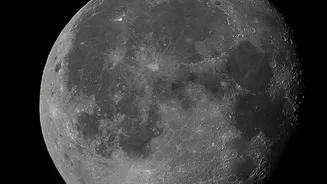




For as long as humans have looked at the night sky, we've seen a face in the Moon. But the familiar dark patches that form the 'eyes' and 'mouth' aren't just shadows. They are scars from a violent, fiery past, telling a fascinating geological story.
The Seas That Hold No Water
The
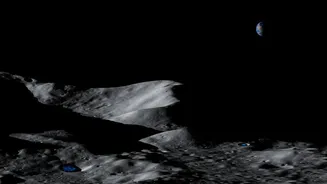
dark, smooth plains on the Moon are called 'maria', which is Latin for 'seas'. Early astronomers in the 17th century, peering through the first telescopes, genuinely believed these vast, dark expanses were oceans. They gave them poetic names that we still use today, like Mare Tranquillitatis (Sea of Tranquility) and Oceanus Procellarum (Ocean of Storms). Of course, we now know there is no liquid water in these 'seas'. Instead, they are enormous, flat plains of solidified lava that cover about 16% of the Moon's surface.
A Violent, Fiery Past
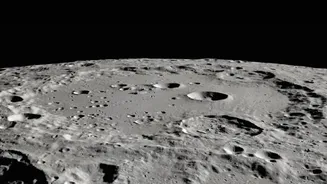
The story of the maria is a two-act drama. The first act began billions of years ago when the Moon was subjected to a period of intense bombardment by massive asteroids. These cataclysmic impacts were so powerful that they punched huge craters, known as impact basins, into the young lunar crust. The second act came later. For hundreds of millions of years following the impacts, the Moon's interior was still volcanically active. Magma from deep within the mantle welled up through fissures in the weakened crust, flooding these enormous basins. This lava wasn't like the thick, slow-moving lava we might picture on Earth; it was incredibly fluid, spreading out to form vast, smooth sheets before cooling and hardening into the dark plains we see today.
Why Are They So Dark?
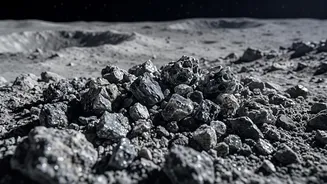
The distinct contrast between the dark maria and the brighter, cratered areas comes down to chemistry. The lava that formed the maria is a type of volcanic rock called basalt, which is rich in iron, magnesium, and titanium. These elements make the rock naturally darker and much less reflective of sunlight compared to the surrounding terrain. The brighter areas, known as the lunar highlands or 'terrae', are made of a lighter-coloured rock called anorthosite. This rock formed the Moon's original crust, and because it's older and wasn't covered by lava flows, it bears the scars of countless more crater impacts over billions of years.
The Two Faces of the Moon
One of the most curious lunar mysteries is why the side of the Moon facing Earth is covered in these dark maria, while the far side has very few. While a definitive answer is still debated, the leading theory relates to the Moon's formation and its relationship with Earth. When the Moon was young and still molten, the intense heat radiating from the hot, early Earth kept the near side warmer for longer. This caused the crust on the near side to form more thinly than on the cooler, far side. As a result, when asteroids later struck the near side, their impacts could more easily rupture the thinner crust, allowing magma to flood the surface. On the far side, the crust was simply too thick for most impacts to break through.
A Landmark for Humanity
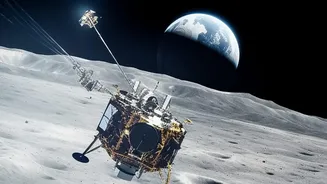
These ancient lava plains are not just geological curiosities; they are a part of our own history. The flat, smooth surface of the maria made them ideal targets for the first human explorers. On July 20, 1969, the Apollo 11 mission's lunar module, named 'Eagle', touched down in the Sea of Tranquility (Mare Tranquillitatis), a site chosen specifically for its relative lack of boulders and steep slopes. When Neil Armstrong took his 'one small step', he did so onto the dark, basaltic dust of a sea that was born from volcanic fire billions of years ago, forever linking human achievement with the Moon's deep past.