



Let's Check the Math
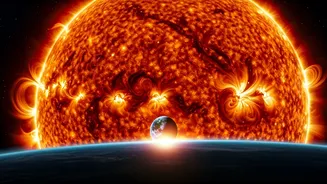
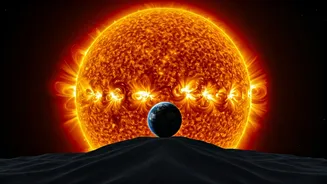
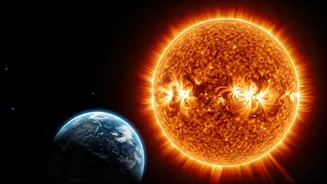
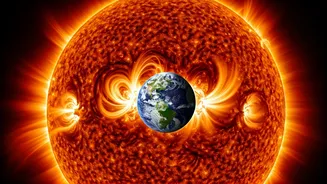
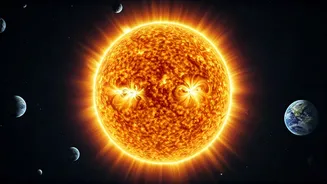
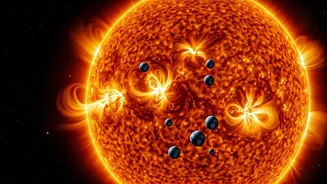
First, let's get specific, because the reality is even more impressive. According to NASA, the Sun is so vast that you could actually cram about 1.3 million Earths inside it. The headline's 'one million' is a nice, round number, but the universe rarely
deals in clean figures. So how do scientists arrive at that number? It’s a question of volume. You can’t just line up Earths side-by-side; you have to imagine filling a giant, empty sphere (the Sun) with tiny marbles (Earths). The Sun’s diameter is about 865,000 miles, which is roughly 109 times the diameter of Earth. But for volume, you have to cube that relationship. Think of it this way: if a box is twice as long, twice as wide, and twice as tall as another box, it can hold eight times the stuff (2x2x2), not just twice as much. The same principle applies here, leading to that mind-boggling 1.3 million figure.
How to Picture 1.3 Million Earths
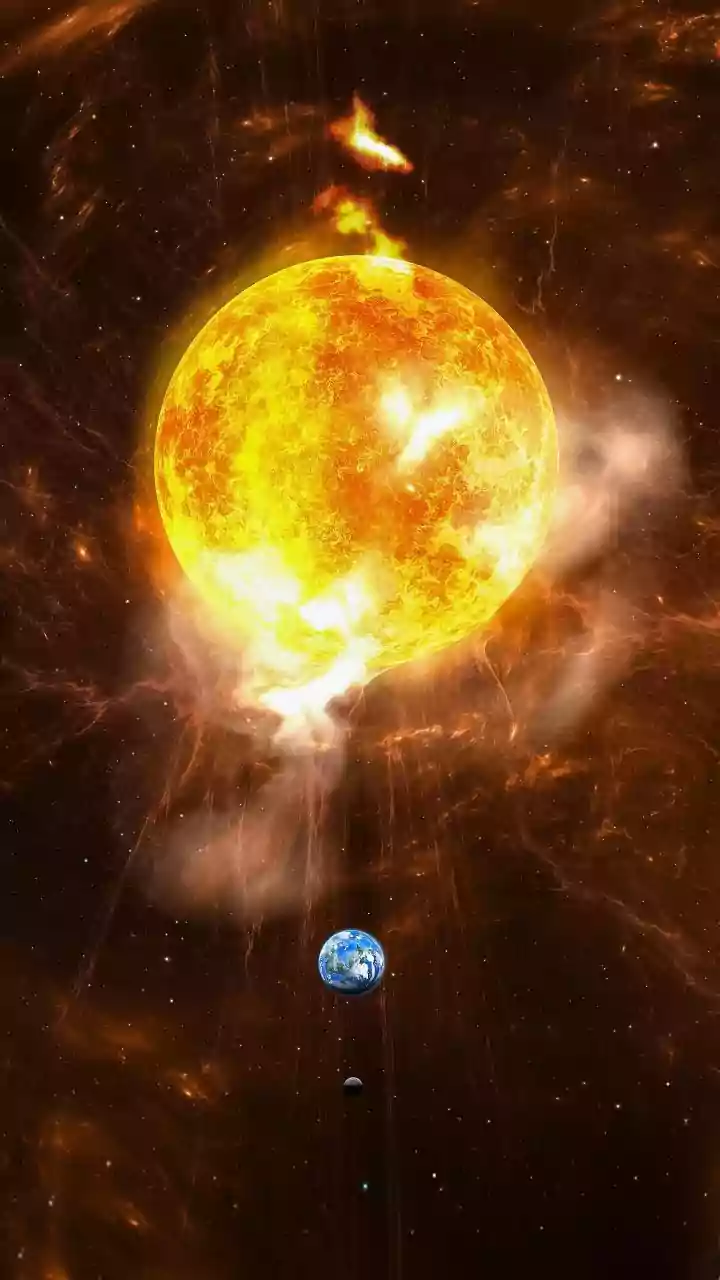
Our brains aren't built to comprehend a number that large, so analogies are our best friend. If you imagine the planet Earth is the size of a single green pea, the Sun would be a gigantic sphere about five feet in diameter—roughly the size of a large yoga ball or a small car. Now, picture trying to fill that massive ball with over a million peas. That’s the scale we’re dealing with. Here’s another way to think about it: if you decided to count every single one of those 'Earths' inside the Sun, at a rate of one per second without ever stopping to eat or sleep, it would take you more than 15 straight days to finish. The sheer emptiness of space allows for objects of this magnitude to exist, governing their own systems through immense gravitational pull.
It's Even Heavier Than It Looks
The Sun’s dominance isn't just about size; it's also about mass. While it’s 1.3 million times larger than Earth by volume, it’s only about 333,000 times more massive. This tells us that the Sun is, on average, less dense than our rocky little planet. Earth is made of iron, rock, and metal, while the Sun is a superheated ball of hydrogen and helium gas. But don't let the lower density fool you. The Sun’s mass is so colossal that it accounts for 99.86% of all the mass in our entire solar system. Everything else—Jupiter, Saturn, all the other planets, moons, asteroids, and comets combined—makes up the leftover 0.14%. Our star doesn’t just light up the neighborhood; for all practical purposes, it *is* the neighborhood. Every other object is just along for the gravitational ride.
Our Sun Is Actually Just Average
Here is perhaps the most humbling fact of all: our Sun, the star that can hold 1.3 million Earths and contains nearly all the matter in our solar system, is a fairly average, even modest, star in the grand scheme of the universe. Astronomers classify it as a yellow dwarf. There are red dwarfs that are far smaller and dimmer, but there are also blue giants and red hypergiants that make our Sun look like a tiny spark. One of the largest known stars, UY Scuti, has a volume so immense it could contain roughly 5 billion Suns. That’s not a typo. You could fit billions of our solar systems inside that single star. It’s a cosmic Russian doll of scale, where each new layer reveals a size more incomprehensible than the last, stretching our perspective from planetary to galactic.