



Our Place in the Cosmos
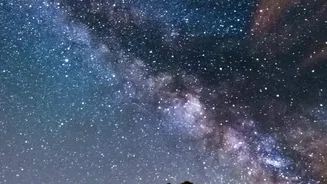
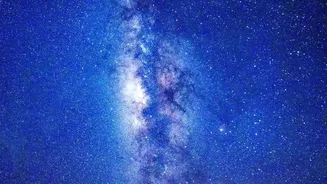
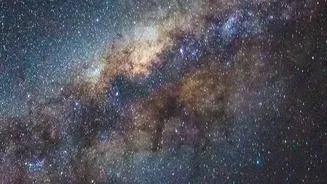
When we look up at the night sky, nearly every star we can see with the naked eye is part of our home galaxy, the Milky Way. But our galaxy isn't alone. It’s a leading member of a gravitationally bound collection of over 50 galaxies known as the Local
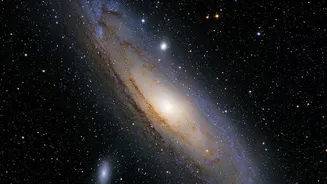
Group. This group, which includes the massive Andromeda galaxy and many smaller dwarf galaxies, is our cosmic neighbourhood. Spanning about 10 million light-years, these groups are the most common galactic structures in the universe. Understanding how they came together, and how they change over billions of years, is a central puzzle in astronomy. It’s the story of how the lumpy, structured universe we see today emerged from the remarkably smooth state of the early cosmos.
The Cosmic Dance of Gravity
For decades, the accepted theory of cosmic evolution has been one of hierarchical formation. In this model, the invisible scaffolding of dark matter pulls together small pockets of gas to form the first stars and small galaxies. Over aeons, gravity continues its work, drawing these smaller structures together into larger groups and eventually massive clusters. This process is a chaotic and violent one, marked by frequent mergers and collisions that shape the galaxies involved. Astronomers believed these mergers were a primary driver of evolution, often triggering bursts of star formation before a powerful quasar, ignited by the collision, would ultimately shut it down. This 'merger-quasar-quench' model helped explain why some galaxies are teeming with new stars while others are quiet and retired.
A Violent Past and a Cosmic Flip
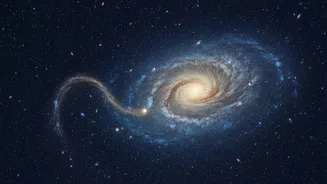
Recent findings are adding a dramatic new twist to this story. Using powerful supercomputer simulations to analyse galaxies similar to our own, astronomers have found that major, head-on collisions can have a much more profound effect than previously realised. Research presented in July 2026 suggests that a massive collision in the Milky Way's distant past, about 10 billion years ago with a galaxy nicknamed the 'Gaia-Sausage', may have caused our entire galactic disc to flip over, changing its orientation by more than 90 degrees. This violent event helps explain a long-standing mystery: why the vast, sparse halo of stars surrounding our galaxy rotates so slowly. According to the simulations, galaxies with slow-rotating halos have consistently experienced both a major merger and a subsequent disc flip. This suggests that the evolution of our cosmic neighbourhood is not just about slow accumulation but is punctuated by dramatic, transformative events that can reorient entire galaxies.
Rewriting the Rules of Mergers
Other new research, also from July 2026, challenges the long-held belief that galaxy mergers are the primary cause for shutting down star formation. By leveraging the advanced IllustrisTNG simulation, one of the most sophisticated models of our universe, scientists found that mergers are not the main culprit in 'quenching' galaxies. While a collision can initially trigger a flood of star formation, the simulation shows it doesn't consistently lead to the galaxy becoming dormant. This forces a rethink of how galaxies mature and die. The answer might lie less in these spectacular collisions and more in other processes, like the galaxy's supply of cold gas being cut off, a phenomenon sometimes called 'strangulation'. Another recent study found that matter is being pushed much farther out from galaxies than models predicted, suggesting that internal processes like explosions from stars and jets from black holes are far more violent than previously thought.
The Future of Cosmic Archaeology
These discoveries highlight how much is still left to learn about our cosmic origins. The faint, ghostly structures in the outskirts of galaxies hold the key, acting as a fossil record of their entire history. A newly approved European Space Agency mission called ARRAKIHS, scheduled to launch in 2030, is designed specifically to study these faint outer regions. It will survey dozens of nearby galaxies to map their stellar halos and streams, providing the raw data needed to test these new theories. By combining these future observations with increasingly powerful simulations, astronomers hope to build a complete and detailed history of not just our own Milky Way, but of our entire cosmic neighbourhood.