




Decoding Starlight Signals
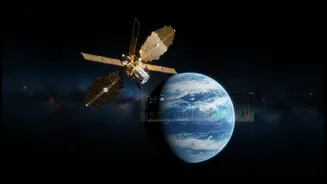
The primary method for studying these distant atmospheres is a technique called transit spectroscopy. As an exoplanet passes in front of its host star from our point of view, a tiny fraction of the starlight filters through the planet's atmosphere. Telescopes
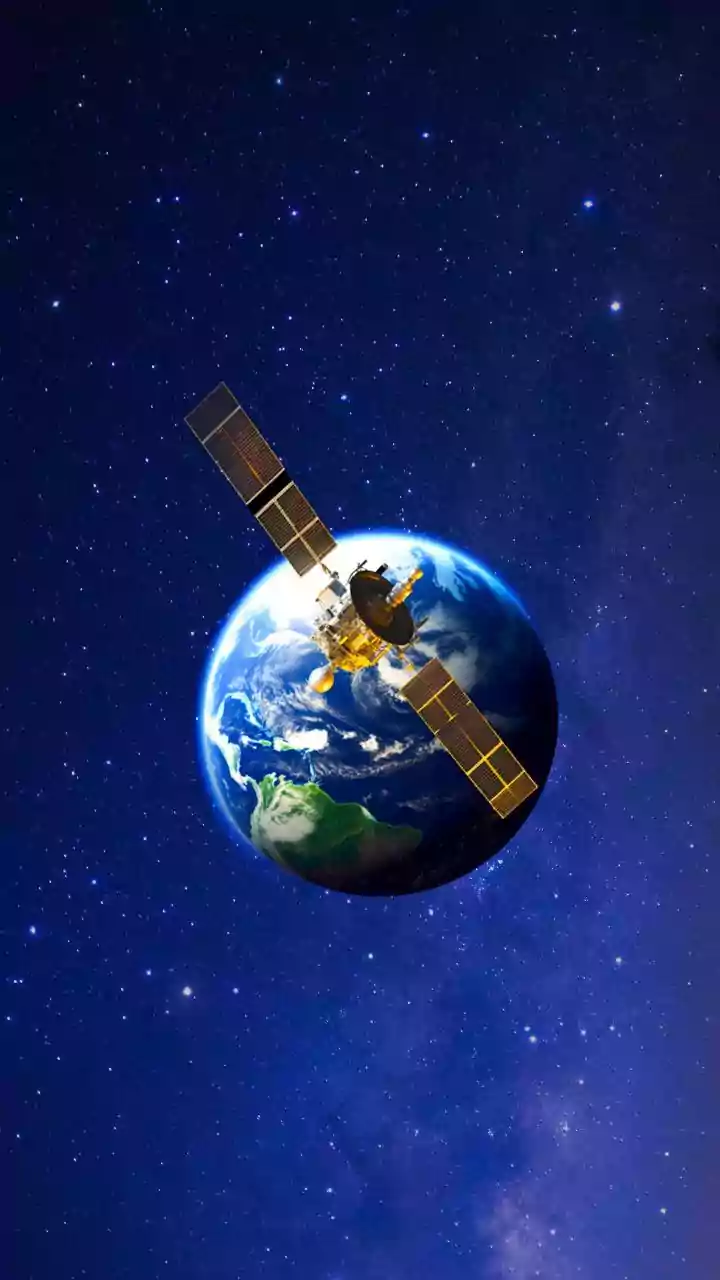
like the James Webb Space Telescope (JWST) can capture this light and analyse its spectrum. Different molecules in the atmosphere absorb specific colours, or wavelengths, of light, leaving behind a unique chemical signature, like a cosmic barcode. Water vapour, in particular, has a very distinct and recognisable signature in this spectrum, allowing scientists to confirm its presence even across immense distances.
Water as a Cosmic Thermometer
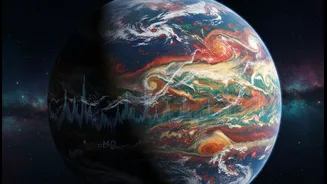
Detecting water is just the first step. The real magic happens when scientists analyse the details of its signature. The properties of the water signal—its strength and the specific wavelengths where it appears—can tell astronomers a great deal about the temperature and pressure at different layers of the gas giant's atmosphere. For example, on an ultra-hot gas giant, water molecules might be torn apart by the intense heat, so finding any intact water speaks to the telescope's sensitivity and provides crucial temperature constraints. By studying how the water signature changes, researchers can build a temperature profile with depth, essentially taking the planet's atmospheric temperature from light-years away.
Mapping Clouds and Haze
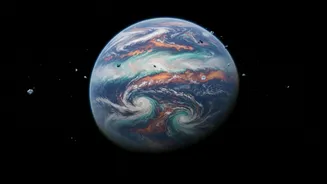
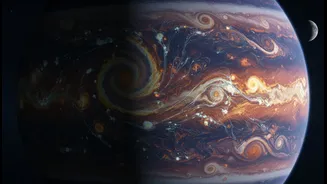
Gas giants are known for their thick clouds and haze, which can obscure the layers below. Here again, water proves invaluable. The presence and state of water vapour help differentiate between cloud layers. On planets like Jupiter and Saturn, clouds are composed of frozen crystals of ammonia, ammonium hydrosulfide, and water, each forming at a different temperature and altitude. By identifying the signature of water vapour, scientists can infer where it's warm enough for water to exist as a gas versus where it's cold enough to condense into ice clouds. This allows them to map the vertical structure of the atmosphere, revealing the altitude of different cloud decks and hazy layers that previous observations could not detect.
Clues to a Planet's Past
Perhaps most profoundly, the amount of water in a gas giant's atmosphere provides critical clues about its formation. The composition of a planet is directly linked to where in its early solar system it was born. In the colder outer regions of a protoplanetary disk, water exists as ice, which can be readily incorporated into a forming planet. In contrast, planets that form closer to their star are born in a region where water is a vapour and less easily captured. By measuring the abundance of water and other heavy elements (what astronomers call a planet's 'metallicity'), scientists can test theories of planetary formation. A surprisingly low amount of water, for instance, might suggest the planet formed without collecting a lot of ice, challenging existing models.
A New Era of Exploration
While the Hubble Space Telescope first detected water in an exoplanet's atmosphere in 2013, the advanced capabilities of the James Webb Space Telescope have revolutionised this field. Its powerful instruments can capture far more detailed spectra, revealing subtle water signatures that were previously invisible. This has enabled astronomers to study a wider range of planets, from hot Jupiters to smaller sub-Neptunes, and to characterise their atmospheres in unprecedented detail. Each detection not only tells us about a specific world but also helps us understand the diversity of planets across our galaxy.