


What Is an Equinox?
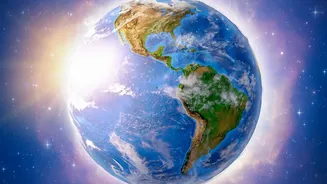
The word equinox comes from the Latin for "equal night," and that’s a great starting point. It marks the two moments in the year when the sun is positioned directly above the Earth's equator. Because of this alignment, sunlight illuminates the Northern
and Southern Hemispheres almost equally. The result is that day and night are nearly the same length everywhere on the planet. This happens twice: once around March 20, known as the vernal or spring equinox in the Northern Hemisphere, and again around September 22, the autumnal equinox. These events signal the astronomical start of spring and autumn, respectively. While we often talk about it as a day, the equinox is technically a specific instant in time when the center of the Sun passes over the plane of our planet's equator.
It's All About the Tilt
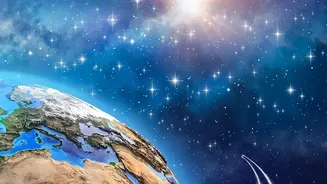
A common misconception is that seasons are caused by Earth's changing distance from the Sun. In reality, our planet is actually closest to the Sun in January—during winter in the Northern Hemisphere. The true reason for the seasons is Earth's axial tilt. Our planet is tilted on its axis by about 23.5 degrees. As we orbit the Sun, this tilt means that different parts of the planet receive more direct sunlight at different times of the year. When the Northern Hemisphere is tilted toward the Sun, its rays hit more directly, creating the longer, warmer days of summer. When it's tilted away, we get the less direct sunlight and colder temperatures of winter. The equinoxes are the midway points in this journey. At these times, the tilt is sideways relative to the Sun; neither hemisphere is tilted more toward or away from it than the other. This is why both hemispheres receive a similar amount of light.
Equinox vs. Solstice
The equinoxes represent balance, while solstices represent extremes. They are the four key turning points in Earth's yearly orbit. After the March equinox, the Northern Hemisphere continues to tilt progressively toward the Sun. This culminates in the summer solstice around June 21, the longest day of the year and the official start of summer. Following the summer solstice, the days begin to shorten until we reach the September equinox, where day and night are again nearly equal. After that, the Southern Hemisphere gets its turn to tilt toward the Sun, leading to the winter solstice in the north around December 21—the shortest day of the year. So, while equinoxes are about equality in sunlight, solstices mark the peak of either light or darkness.
An Experience on the Equator
If you were standing on the equator on the day of an equinox, you would experience a unique phenomenon. At midday, the Sun would be directly overhead. An object, like a flagpole, would cast almost no shadow. This is because the subsolar point—the spot on Earth where the Sun's rays are hitting at a 90-degree angle—is on the equator at that moment. On an equinox, the Sun also rises almost exactly due east and sets almost exactly due west for everyone on Earth, a fact ancient cultures used to orient buildings and track the year.
Why 'Nearly' Equal Day and Night?
You might wonder why it's always "nearly" 12 hours of day and 12 hours of night, and not exactly. There are two main reasons for this. First, the Sun isn't a single point of light; it's a large disc. Sunrise is defined as the moment its upper edge appears over the horizon, and sunset is when its upper edge disappears. This adds a few extra minutes of daylight. Second, Earth’s atmosphere acts like a lens, refracting or bending sunlight. This means we see the Sun for a few minutes before it has physically risen above the horizon and for a few minutes after it has set. Because of these factors, the day on which there is precisely 12 hours of light—known as the equilux—actually happens a few days before the spring equinox and a few days after the autumn equinox.
Cultural and Natural Significance
For millennia, cultures around the world have recognized the equinoxes as important transition points. Many celebrations, like the Persian New Year (Nowruz), are tied to the March equinox. In India, the festival of Holi often falls around this time, celebrating the victory of good over evil and the arrival of spring. These events are more than just astronomical markers; they signify rebirth, harvest, and renewal. For ancient agricultural societies, tracking the sun's path was a matter of survival, and the equinoxes told them when to plant and when to reap. This deep connection to the cycles of nature is a reminder of the powerful, predictable dance between Earth and Sun that governs all life.