






First, Let's Redefine 'Day'
Before we unpack Mercury’s strangeness, we need to clarify what a 'day' even is. On Earth, we barely notice the difference between two types of days. A 'sidereal day' is the time it takes for a planet to complete one full 360-degree rotation on its axis.
For Earth, this is about 23 hours and 56 minutes. A 'solar day' is the time it takes for the sun to appear in the same position in the sky — what we call 24 hours. The small difference is because Earth is also moving along its orbit around the sun. For most planets, these two values are pretty close. But on Mercury, they are wildly different, and this is the key to the entire puzzle.
A Fast Year and a Slow Spin
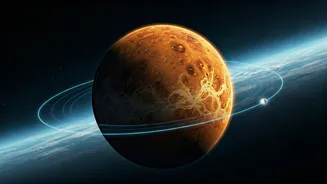
Mercury is the speedster of the solar system. Being the closest planet to the sun, it zips around in its orbit in just 88 Earth days. That’s a Mercurian year. If you lived there, you’d have a birthday every three months! In stark contrast to its speedy year, Mercury is an incredibly slow spinner. It takes about 59 Earth days to complete one full rotation on its axis. This is its sidereal day. So, you have a planet where a year (88 days) is only about 1.5 times longer than its rotation period (59 days). This strange ratio is where the real magic, and the long solar day, comes from.
The Cosmic Dance: A 3:2 Resonance
This isn't a coincidence. Mercury is in what astronomers call a 3:2 spin-orbit resonance. This means that for every two orbits it makes around the sun (2 x 88 = 176 Earth days), it rotates on its axis exactly three times (3 x 59 = 177 Earth days, the numbers are close due to rounding). The sun's immense gravity has tugged on Mercury over billions of years, locking its spin into this stable, repeating pattern. Think of it like a dancer who spins exactly three times for every two laps they take around a stage. This gravitational lock prevents Mercury's rotation from speeding up or slowing down relative to its orbit.
A Sunrise Worth Waiting For
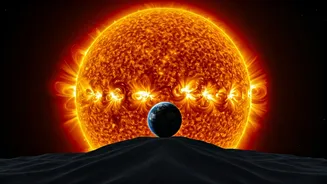
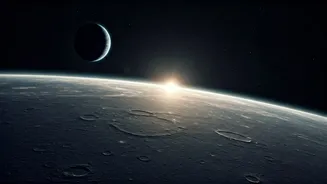
So how does this create a solar day that lasts for 176 Earth days? Let's imagine standing on Mercury and watching the sunrise. The planet is slowly spinning on its axis, but it's also moving very quickly in its orbit. Because the orbital speed is so significant relative to the rotational speed, the sun appears to move incredibly slowly across the sky. By the time Mercury has completed one full rotation (59 days), it has also travelled two-thirds of the way through its orbit. It needs to keep rotating for a long time before the sun finally gets back to the same spot in the sky. The result of this cosmic ballet is a solar day—the time from one sunrise to the next—that lasts for about 176 Earth days. In other words, a single day on Mercury is twice as long as its entire year.
So, What About the Two Months?
The headline's "two months" refers to Mercury's sidereal day—its ~59-day rotation period. While technically a 'day' in the rotational sense, it's not the day you'd experience. The day of light and dark, governed by the sun, is the much longer 176-day cycle. This leads to some bizarre effects. At certain points in Mercury’s eccentric (oval-shaped) orbit, the sun can appear to briefly reverse its course in the sky before resuming its slow crawl. This happens because the planet's orbital speed changes, but its spin remains constant. It's a world of extreme temperatures and temporal weirdness, all dictated by the relentless pull of the sun.