








What Is Aphelion, Exactly?
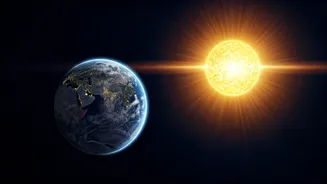
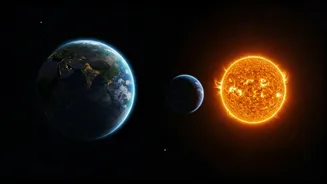
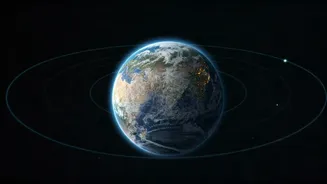
In simple terms, aphelion is the point in Earth's yearly orbit when it is farthest from the Sun. This happens because our planet’s path around the Sun isn't a perfect circle; it's a slightly stretched-out, oval shape called an ellipse. Because the Sun isn't perfectly
in the centre of that oval, there are times when we are a bit closer and times when we are a bit farther away. The closest point is called 'perihelion,' which happens in early January, while aphelion occurs in early July. For 2026, Earth will reach aphelion on July 6. The words themselves come from Greek: 'apo' meaning away, and 'helios' meaning Sun.
The Myth of the Aphelion Chill
Every year, messages circulate claiming that aphelion will cause unusually cold weather. This is a persistent myth. While Earth will be approximately 5 million kilometres farther from the Sun on July 6, 2026, than it was during its closest approach in January, this has a negligible effect on our planet's temperature. That extra distance represents only about a 3% change in the total distance between Earth and the Sun. The variation in solar energy reaching us is too small to cause any noticeable drop in temperature. In fact, for the entire Northern Hemisphere, aphelion occurs right in the middle of summer.
The Real Reason for the Seasons
If distance isn't the cause, why do we have seasons? The answer lies in Earth's axial tilt. Our planet is tilted on its axis by about 23.5 degrees. This tilt means that for part of the year, the Northern Hemisphere is angled more directly towards the Sun, receiving more concentrated sunlight and experiencing summer. At the same time, the Southern Hemisphere is tilted away, getting less direct sunlight and having its winter. Six months later, the situation is reversed. The fact that the Northern Hemisphere's summer coincides with aphelion—our farthest point from the Sun—is the best proof that the tilt, not the distance, is what truly governs our seasons. The directness of the sun's rays and the length of the days are far more important factors for temperature than our slight orbital variance.
A Slower Orbit and Longer Summers
While aphelion won't give you a sudden chill, it does have a subtle effect. According to Kepler's laws of planetary motion, a planet moves more slowly when it is farther from the Sun. Because Earth reaches aphelion during the Northern Hemisphere's summer, our planet is actually moving at its slowest orbital speed during this time. This makes the northern summer the longest of the four seasons by a few days. Conversely, the Southern Hemisphere's winter is the longest season for those living below the equator. This effect is a fascinating consequence of our elliptical orbit but, once again, doesn't impact the temperature in any significant way.
Why Aphelion Still Matters
So, if it doesn't change the weather, should we care about aphelion at all? For most of us, it's a piece of cosmic trivia. But for astronomers and space agencies, understanding concepts like aphelion and perihelion is critical. These orbital points are fundamental to calculating planetary movements, planning space missions, and sending probes to other worlds. Knowing the precise location and speed of planets in their orbits is essential for navigating the solar system. For the rest of us, aphelion serves as a great annual reminder of the elegant, complex dance of celestial mechanics happening all around us, and a perfect opportunity to understand the real science that shapes our world.