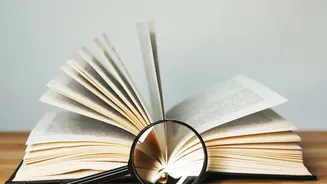







The Guilt of the Unread Shelf
There's a Japanese word for the act of acquiring books and letting them pile up unread: 'tsundoku'. It describes those stacks on the bedside table or the volumes on the shelf you swear you'll get to 'one day'. For many, this collection becomes a source
of low-grade anxiety—a visual to-do list that’s never quite finished. We live in a culture that quantifies reading, celebrating the number of books finished per year. In this context, an unread book can feel like a personal failing. But this perspective misses a crucial distinction between books meant to be devoured as a narrative and those that serve a completely different, yet equally important, purpose in our lives.
A Tool, Not a Story
Not all books are created equal, nor are they intended for the same type of engagement. A novel or a memoir tells a story, pulling you along a linear path from beginning to end. To get its value, you must read it through. A reference book, however, is a tool. Think of a dictionary, a cookbook, an encyclopedia, or a field guide to local birds. You wouldn't sit down and read a dictionary from 'aardvark' to 'zyzzle'. You consult it when you need a specific piece of information. Its value lies in its availability and authority, not in its narrative flow. These books are designed for dipping into, for browsing, for answering a specific question that pops into your head. Their usefulness is realised in moments of need, not through a marathon reading session.
Embracing Your 'Antilibrary'
Writer and thinker Nassim Nicholas Taleb popularized a powerful concept for reframing your relationship with unread books: the 'antilibrary'. The term was originally coined by Umberto Eco, a novelist and scholar who owned a personal library of over 30,000 volumes. Taleb argues that the books you haven't read are far more valuable than the ones you have. Your library is not an ego-boosting trophy case of everything you know, but a research tool that reminds you of everything you don't know. This collection of unread books—your antilibrary—is a constant, physical reminder of the vastness of knowledge, fostering intellectual humility and sparking curiosity. It represents potential and the promise of future learning.
The Power of Physical Presence
In an age of endless digital information, the physical presence of a reference book offers unique advantages. There is a serendipity in flipping through an atlas or a book of quotations that an algorithm-driven search can't replicate. You might look up one thing and discover three other fascinating facts along the way. Studies have also suggested that reading on paper can lead to better comprehension and recall compared to screens. A physical book is also a finite, stable object. It is free from the distractions of notifications and hyperlinks that can pull your attention away when reading on a device. Having a well-stocked shelf of reference works means that reliable, curated information is always within arm's reach, independent of battery life or an internet connection.
More Than Just Dictionaries
This idea extends beyond traditional reference titles. It can apply to dense works of philosophy, complex scientific texts, or collections of poetry. You may never read Adam Smith's 'The Wealth of Nations' from cover to cover, but by having it on your shelf, you've made an investment in your own curiosity. You can pull it down to understand a specific concept, read a single chapter that interests you, or simply let its presence be a reminder of the foundational ideas of modern economics. These books are invitations to think, to question, and to learn on your own terms. They are not waiting to be 'completed' like a task, but to be engaged with over a lifetime, whenever inspiration strikes.