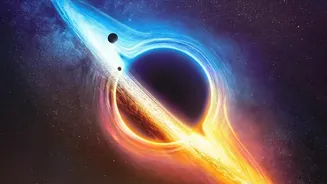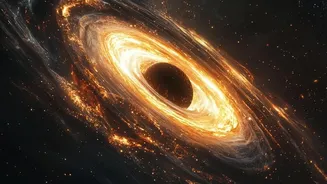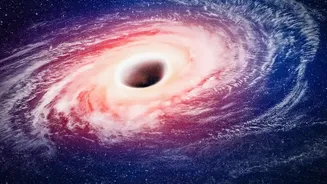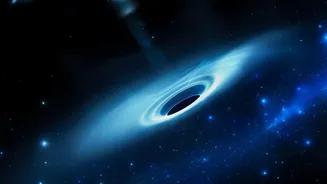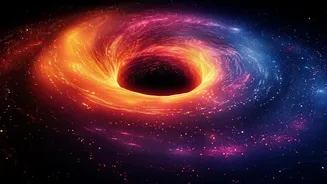




When you picture a black hole, you probably imagine a giant star collapsing under its own weight. For years, that was the standard story. But new research suggests that some black holes have a much more exotic and ancient origin story.
The Textbook Black Hole
For decades, the
origin story of most black holes seemed straightforward. A massive star, many times the size of our own sun, reaches the end of its life. Having exhausted its nuclear fuel, the delicate balance between the outward pressure of fusion and the inward crush of gravity is broken. Gravity wins, catastrophically. The star's core collapses into an infinitely dense point, creating a stellar-mass black hole. This process was considered the primary, if not sole, factory for producing these cosmic objects, ranging from a few to a hundred times the mass of our sun. While scientists have long been puzzled by the origins of supermassive black holes, which are millions or billions of times heavier, the story for their smaller cousins seemed settled. But recent discoveries are adding a surprising new chapter.
Whispers of a Different Origin
The latest findings, particularly from gravitational wave observatories like LIGO, Virgo, and KAGRA, are painting a more complex picture. These detectors listen for the faint ripples in spacetime caused by the collision of massive objects, like black holes merging. By analysing these signals, scientists can determine the mass and spin of the colliding objects. What they've found is puzzling. Some black holes appear to have masses that shouldn't be possible through standard stellar collapse. There's a predicted 'mass gap'—a range of masses where stars are expected to blow themselves apart completely in a pair-instability supernova, leaving no black hole behind. Yet, gravitational wave detectors have found black holes sitting squarely in this forbidden zone. This has forced astronomers to consider alternative formation pathways.
Cosmic Heirlooms: A Second Generation
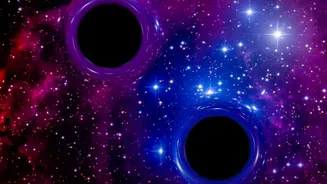
One leading theory is that these oddball black holes aren't first-generation objects born from stars. Instead, they could be second-generation, or 'hierarchical', black holes. This idea proposes that in extremely dense environments like star clusters, smaller black holes can merge. The result of that merger, a new and more massive black hole, can then go on to merge again. Recent analysis from MIT scientists suggests that roughly 14 percent of merging black holes might have merged at least once before. The distinct spin patterns of these heavier black holes support this idea; unlike their slower-spinning, star-born relatives, these objects often spin rapidly and in seemingly random directions, a tell-tale sign of a violent merger history.
Even Smaller, Even Weirder
The plot thickens further with the potential detection of even smaller black holes—some with masses less than our own sun. Since stars that small don't have enough mass to collapse into a black hole, their existence points to a completely different origin: primordial black holes. First theorized by Stephen Hawking, these objects are thought to have formed not from stars, but from intense density fluctuations in the hot, soupy universe moments after the Big Bang. A recent, unusual signal detected by LIGO pointed to a merger involving an object with a subsolar mass, providing the most tantalizing clue yet that these ancient black holes might be real. While the signal could be instrumental noise, many researchers believe it's the first hint of a vast, hidden population of cosmic relics.
Solving the Universe's Biggest Mysteries
Confirming the existence of primordial black holes would be more than a cosmic curiosity; it could help solve one of the biggest mysteries in physics: dark matter. This invisible substance makes up about 85% of the matter in the universe, providing the gravitational scaffolding that holds galaxies together, but its nature is unknown. Some scientists now propose that primordial black holes could account for a significant portion, or perhaps all, of the universe's dark matter. This would elegantly solve two cosmic puzzles at once. The search is now on, with researchers using gravitational wave data and gamma-ray telescopes to hunt for more evidence of these elusive, ancient objects that may have been hiding in plain sight all along.