




What Is That Crunching Sound?
The medical term for this noisy joint phenomenon is 'crepitus'. It describes any popping, cracking, or grinding sound or sensation in a joint during movement. In many cases, knee crepitus is harmless, caused by tiny gas bubbles forming and collapsing
in the synovial fluid that lubricates the joint. It can also be the sound of ligaments or tendons gliding over the bony structures of your knee. While occasional, painless crepitus is generally not a cause for concern, you shouldn't ignore it entirely. When the sound becomes persistent or is accompanied by pain, swelling, or stiffness, it may signal an underlying issue like cartilage wear or inflammation. It serves as a crucial signal that something about your movement or alignment is off-balance.
The Desk Job and Knee Health Connection
A sedentary lifestyle is a primary contributor to knee problems. Prolonged sitting, especially with poor posture, weakens the muscles that support the knee, including the quadriceps and glutes. This weakness forces the knee joint to take on more strain. An improperly arranged workstation compounds the problem. If your chair is too high or too low, forcing your knee into an awkward angle, or if you habitually cross your legs, you place undue stress on the knee joint and its surrounding tissues. Over time, this can lead to patellofemoral pain syndrome, where the kneecap (patella) doesn't track smoothly, causing cartilage to wear down and leading to the grinding sensation of crepitus.
An Ergonomic Audit for Your Knees
The good news is that you can make immediate changes to create a more knee-friendly workspace. The goal is to align your body to minimize joint strain. Start with the '90-90-90' rule: your ankles, knees, and hips should all be at roughly 90-degree angles. Adjust your chair height so your feet rest flat on the floor with your thighs parallel to it. If your feet don't reach, use a footrest to relieve pressure. Ensure there is a small gap of about one to two inches between the back of your knees and the edge of the chair seat. Your desk should also have enough clearance underneath so you can move your legs freely and not feel cramped.
Posture Is a Whole-Body Issue
Proper alignment isn't just about how you sit. Your overall posture dictates how forces are distributed through your body, and your knees often compensate for misalignments elsewhere. A forward-leaning posture, common among desk workers, shifts your centre of gravity and places excessive pressure on the front of your knees. Similarly, a weak core or an overly tilted pelvis forces the lower body into an unnatural position, increasing wear and tear on the knee joints. Being mindful of your posture while standing and walking is just as important as when you are sitting. Avoid locking your knees when standing and try to distribute your weight evenly across both feet.
Simple Movements for Desk-Bound Knees
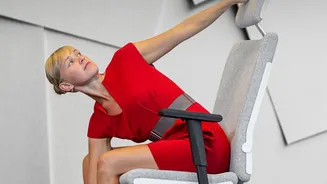
Counteracting the effects of a sedentary job requires movement. The most important habit is to take regular breaks. Get up, walk around, and stretch every 30 minutes if possible. You can also perform simple exercises right at your desk to improve knee mobility and strengthen supporting muscles. A great one is the seated knee extension: while sitting upright, slowly extend one leg until it's straight and parallel to the floor, hold for a few seconds, and then lower it back down. Simple hamstring and quad stretches while standing can also keep the muscles around the knee flexible. These small but consistent movements improve circulation, reduce stiffness, and support long-term joint health.