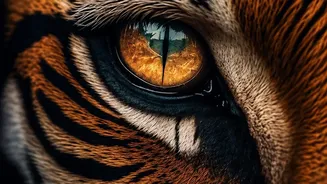






The tiger's coat is one of the most iconic patterns in the natural world. But those bold black stripes aren't just a feature of its fur. In a surprising biological twist, the pattern is imprinted directly onto the animal's skin.
More Than a Striped Coat
It’s a fact that surprises
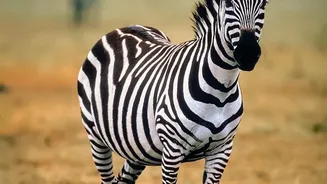
many: if you were to shave a tiger, you would not find plain, uniform skin underneath. Instead, you would see the exact same pattern of stripes that adorned its fur, tattooed directly onto its flesh. This isn't just a coincidence; it's a fundamental aspect of the tiger's biology. The stripes are not a superficial layer of decoration but a blueprint written into the animal’s very skin from its earliest stages of development. This phenomenon is quite rare in the animal kingdom. A zebra, for instance, has famously striped fur, but its skin underneath is uniformly black. A polar bear’s white fur conceals black skin designed to absorb heat. The tiger, however, is striped through and through.
The Science of the Stripes
The secret to this deep-seated pattern lies in specialized cells called melanocytes. During a tiger's embryonic development, these pigment-producing cells arrange themselves in a genetically predetermined pattern across the skin. They produce melanin, the pigment responsible for dark coloration. Where the skin has a high concentration of active melanocytes, it becomes dark, and the hair follicles in that area are instructed to produce black fur. Where the melanocyte activity is low, the skin remains lighter, and the follicles produce the familiar orange-hued fur. The result is a perfect one-to-one map: a dark stripe on the skin corresponds directly to a black stripe in the fur, making the pattern an integral part of the tiger's physiology.
A Feline Fingerprint
Just like a human's fingerprints, no two tigers have the exact same stripe pattern. This uniqueness is a crucial tool for wildlife researchers and conservationists. By using camera traps, scientists can identify, track, and monitor individual tigers in the wild, helping them to understand population dynamics, territory ranges, and overall health. The reliability of this method hinges on the fact that the stripes are a permanent, unchanging feature. Since the pattern is embedded in the skin itself, it remains constant throughout the tiger's life, providing a reliable form of natural identification.
Designed for the Hunt
A tiger's stripes are the ultimate tool for an ambush predator. This form of camouflage is known as 'disruptive coloration'. The vertical stripes break up the tiger's body outline, helping it blend seamlessly into the tall grasses and the dappled light of the forest, where vertical patterns of light and shadow are common. While the bright orange might seem conspicuous to us, many of the tiger's prey, like deer, have dichromatic vision, meaning they are effectively red-green colorblind. To them, the tiger's orange coat appears as a shade of green, allowing it to merge with the surrounding foliage. The stripes complete the illusion, making it incredibly difficult for prey to spot the predator until it's far too late.
What About Other Big Cats?
This skin-deep patterning isn't universal across all big cats. While tigers are striped to the skin, and snow leopards are known to have spots on their skin as well, the trait is not consistent among all patterned felines. Cheetahs, for example, have their signature solid black spots, and research has found that the gene responsible also affects pigmentation on the skin, creating a corresponding pattern. Leopards and jaguars, known for their more complex 'rosette' patterns, also have skin markings, though the correlation is not always as perfectly mirrored as in tigers. Meanwhile, lions are born with faint spots that typically fade as they mature, leaving them with a largely unpatterned coat and skin in adulthood, better suited for the open habitats they command.