




The Basic Ingredient for Life
The excitement begins with a simple truth: all life as we know it requires water. It's the universal solvent, facilitating the chemical reactions that make biology possible. While life could theoretically exist based on other chemistries, water is the most
statistically likely foundation. So, when astronomers search for potentially habitable worlds among the thousands of known exoplanets, the presence of water is their top clue. It's the first and most critical filter in a long and complex search. Finding water vapour in a planet's atmosphere is the first step to checking this box.
Reading an Alien Atmosphere
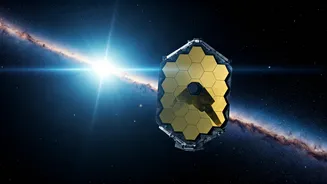
Water vapour does more than just hint at the potential for life; it's a powerful tool for understanding a planet's atmosphere. Scientists detect it by using powerful tools like the James Webb Space Telescope (JWST). When an exoplanet passes in front of its star from our perspective, a tiny fraction of the starlight filters through the planet's atmosphere. By analysing this light with a technique called transmission spectroscopy, scientists can spot the unique chemical 'fingerprint' of water molecules. The presence and amount of water vapour helps researchers understand the planet's temperature, atmospheric density, and even the presence of clouds, which have been detected on worlds like WASP-107b.
A Signpost for the 'Goldilocks Zone'
The discovery of water vapour is a key piece of evidence in determining if a planet lies within its star's 'habitable zone'. Often called the 'Goldilocks zone', this is the orbital region where conditions are not too hot and not too cold, allowing for liquid water to potentially exist on a planet's surface. Earth sits comfortably in our sun's habitable zone. While a planet's position is a good first guess, an atmosphere is what truly governs its surface temperature. The presence of water vapour, a potent greenhouse gas, can provide crucial data to model whether a planet in the right location could actually sustain liquid water, or if it's a frozen iceball or a scorching, Venus-like hothouse.
It's Not a Guarantee of Life, But a Start
It's crucial to understand that finding water vapour is not the same as finding life. Many planets where water has been detected, like the scorching GJ 486 b or the steamy GJ 9827d, are far too hot to be habitable. Furthermore, scientists must be careful to confirm the water signal is from the planet and not from cool spots on its host star. Water is a biosignature—a substance that could indicate life—but it's just one of many. The real excitement for scientists lies in taking the next step: using the JWST to search for a whole cocktail of atmospheric gases. A combination of water vapour, methane, and carbon dioxide, for instance, would be a much stronger indicator of potential biological activity.
From Speculation to Data-Driven Science
Ultimately, the reason finding water vapour is so thrilling is that it moves the search for extraterrestrial life from the realm of science fiction into the world of data-driven science. For the first time in history, we have the technology not just to find other worlds, but to begin to understand what they are like. Each detection of water, even on an uninhabitable planet, helps scientists refine their models of how planets form and evolve across the galaxy. It provides a vital piece of the puzzle, guiding the search and helping astronomers decide which of the thousands of distant worlds are the most compelling candidates to study in the ongoing quest to find another Earth.