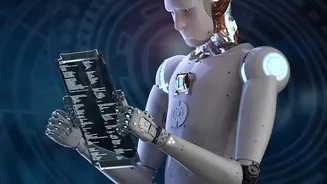







Why Certain Tasks Are First in Line
Artificial Intelligence excels at recognizing patterns, processing vast amounts of information, and executing rule-based instructions without fatigue. This makes it perfectly suited for tasks that are repetitive, predictable, and data-heavy. Think of jobs
that involve sorting, classifying, copying, and summarizing information. According to recent reports, roles heavy on repetitive information processing are highly susceptible to AI integration. Instead of viewing this as a threat, it's more productive to see it as a redefinition of roles. When AI handles the grunt work, human workers are freed up to focus on more strategic initiatives that require a human touch.
Routine Data Entry and Document Management
One of the most immediate impacts of AI is on data entry and management. For decades, office roles have involved manually inputting information from invoices, forms, and reports into digital systems. Today, AI-powered tools can scan documents, extract relevant information, and populate spreadsheets or databases with incredible speed and accuracy. This significantly reduces human error and frees up administrative professionals' time. The new human role in this area shifts from data entry operator to data validator and system manager, ensuring the AI is trained correctly and the outputs are accurate.
Scheduling and Calendar Coordination
The endless back-and-forth of coordinating meetings is a prime candidate for automation. AI-driven scheduling assistants can analyze multiple calendars, propose optimal meeting times, book rooms, and send invites automatically. Tools like Calendly or smart features embedded in Microsoft Outlook and Google Calendar are already common in many workplaces. While this might seem like a small task, studies have shown that automating these administrative duties can save a significant amount of an employee's work week, allowing them to focus on preparing for the meetings rather than just organizing them.
Basic Report and Content Generation
Generative AI models are now capable of creating first drafts of various types of content. This includes summarizing meeting notes, writing routine emails, or generating initial drafts of weekly reports by pulling data from connected systems. For example, an AI can transcribe a virtual meeting, identify key takeaways, and create a concise summary with action items. The human skill then becomes editing, refining, and adding context or strategic insight to this AI-generated foundation, rather than starting from a blank page.
Initial Customer Service Inquiries
Many customer service roles are being augmented by AI. Chatbots and AI voice agents are now the first point of contact for many businesses, capable of answering frequently asked questions and handling standard requests 24/7. This allows human agents to dedicate their time to more complex, sensitive, or high-value customer interactions that require empathy and advanced problem-solving—skills that AI cannot replicate. This transforms the role of a customer service representative from a dispenser of routine information to a true problem solver and relationship builder.
The Pivot: Human Skills in Demand
As AI takes over repetitive tasks, uniquely human skills become more valuable than ever. The future of office work lies not in competing with AI, but in collaborating with it. Professionals who thrive will be those who cultivate skills like critical thinking, emotional intelligence, creativity, and complex problem-solving. The ability to evaluate AI-generated content for bias, accuracy, and relevance is becoming a crucial competency. Similarly, strong communication and leadership skills are needed to help teams adapt to these new technologies and workflows. The focus is shifting from performing the task to supervising and guiding the intelligent systems that perform the task.