
The Ultimate Supply Chain Problem
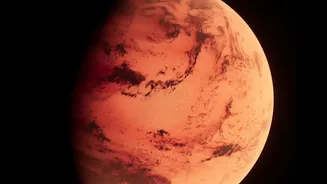
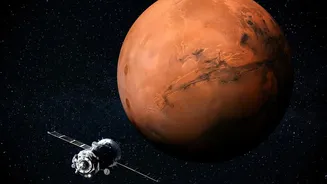
A mission to Mars could last up to three years, and the logistics of packing enough food are staggering. Pre-packaged meals, similar to those used on the International Space Station (ISS), are heavy, take up significant volume, and degrade in nutritional
value over time. Current space food has a shelf life of about 18 months, far short of the potential five years needed for a round trip to Mars, including time on the surface. The sheer mass of food required would make the launch costs from Earth prohibitively expensive. This makes resupply missions impractical and puts a hard cap on how long astronauts can stay. For long-duration stays, relying solely on shipped cargo is not a sustainable option, making in-situ food production an absolute necessity.
More Than Just Calories
Beyond basic survival, fresh food offers critical benefits. Pre-packaged rations suffer from “menu fatigue,” where the monotony can lead to astronauts eating less, risking nutritional deficiencies and low morale. But the act of gardening itself provides significant psychological benefits. Studies and astronaut anecdotes show that caring for plants in an isolated, sterile environment reduces stress, provides meaningful work, and offers crucial sensory stimulation—the sight, smell, and taste of something fresh and living. Astronauts on the ISS who have participated in plant-growing experiments reported finding the tasks enjoyable and engaging. This psychological boost could be just as important as the nutritional value for crews facing years of isolation millions of miles from home.
Gardening in a Hostile Environment
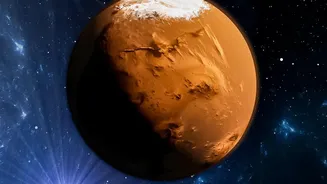
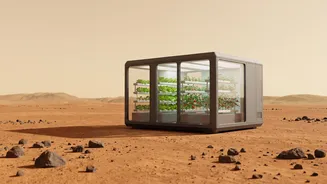
Growing food on Mars presents a unique set of agricultural challenges. The Martian 'soil', or regolith, is not like Earth's soil; it's essentially lifeless crushed rock, lacking the organic matter and microbes necessary for plant growth. It also contains toxic compounds like perchlorates, which would need to be removed. Furthermore, the thin Martian atmosphere, extreme cold, and high levels of solar radiation mean plants cannot simply be grown on the open surface. They would require pressurized, heated, and lit environments, such as greenhouses. Even inside a habitat, resources like water and power would be extremely limited, demanding highly efficient farming methods.
The Rise of the Martian Greenhouse
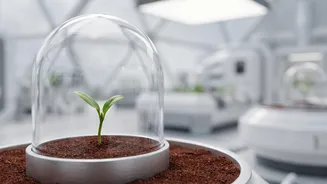
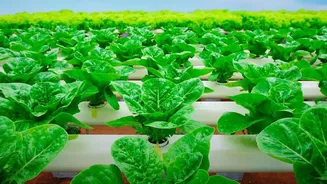
To overcome these hurdles, scientists are developing advanced controlled environment agriculture techniques. Soil-free methods like hydroponics (growing plants in nutrient-rich water) and aeroponics (misting roots with nutrient spray) are leading contenders. These systems use less water, can be stacked vertically to save space, and allow for precise control over nutrient delivery. NASA has already experimented with these technologies on the ISS with its 'Veggie' growth system, successfully growing crops like lettuce. Other research focuses on genetic engineering to create crops that are more resilient to the stresses of a Martian environment or even using bacteria to 'fix' nitrogen from the atmosphere to create fertilizer. Some experiments are even exploring how to use aeroponic systems to gradually break down the Martian regolith and turn it into fertile soil over time.
From Survival to Settlement
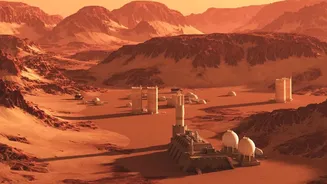
Ultimately, developing a self-sustaining food system is about more than just enabling a single mission; it's the foundational step toward establishing a permanent human presence on Mars. A bioregenerative food system, where plants are grown, waste is recycled, water is purified, and oxygen is generated, creates a small, closed-loop ecosystem. This dramatically reduces dependence on Earth and is the only viable path to long-term settlement. The technologies developed for Martian agriculture also have direct benefits for our home planet, offering innovative solutions for sustainable farming in extreme environments and improving food security on Earth. By learning to farm on another world, we are building the technology not just for exploration, but for true off-world colonization.