




Elon Musk's ambitions rarely stay grounded, and his latest vision is no exception: moving the immense energy and infrastructure demands of AI computing into space. But while the concept is bold, the reality is far from certain.
The Vision: A Data Centre in the Stars
Elon Musk has proposed a radical
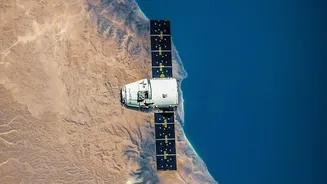
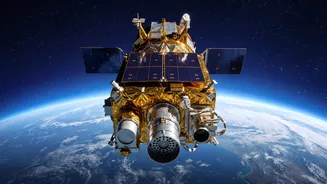
solution to the growing energy and land constraints of terrestrial data centers: launch them into orbit. This concept, dubbed 'Starmind', involves a massive constellation of satellites, potentially numbering in the millions, that would function as solar-powered AI data centers. Recent statements from Musk suggest this is more than just a passing thought. He has floated a timeline where initial demonstration payloads, co-designed with hardware giant Nvidia, could launch as soon as the fourth quarter of 2027. These AI satellites would be large structures, with designs showing a wingspan of over 70 meters, covered in solar panels to harness the constant sunlight available in orbit. The goal is to create a network of computers in space that can handle energy-intensive AI workloads and beam the results back to Earth.
Why Bother With Computing in Space?
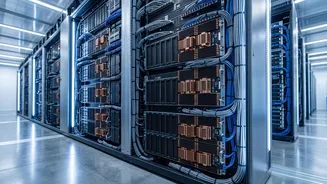
The primary driver for this futuristic idea is a very terrestrial problem: AI is incredibly power-hungry. On Earth, building the gigawatt-scale data centers required for advanced AI is running into significant bottlenecks, including multi-year waits for grid connections, water scarcity for cooling, and local opposition. By moving this infrastructure into space, SpaceX aims to bypass these earthly limitations entirely. In sun-synchronous orbit, solar panels can generate power almost continuously, unaffected by weather or the day-night cycle. This could provide a scalable source of energy to power the next generation of AI. Furthermore, processing data in orbit could drastically reduce latency for the vast amounts of information collected by Earth-observation and other satellites, which currently have to transmit raw data back to the ground for analysis.
SpaceX's Strategic Advantage
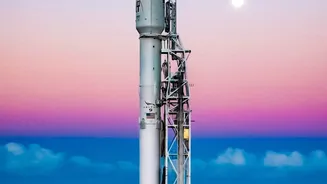
While other companies, including Google, are exploring orbital computing, SpaceX is arguably in a unique position to execute such a plan. The company's vertical integration gives it a massive head start. It has the rockets for transport, specifically the in-development reusable Starship, which is essential for lifting heavy payloads affordably. It has a proven track record of mass-producing satellites for its Starlink constellation, which already numbers over 10,000 active units. And it has the laser-link technology that allows these satellites to communicate with each other in a high-speed mesh network, a critical component for connecting orbital data centers. Musk has argued that much of the technology needed for these AI satellites has already been developed for the latest generation of Starlink satellites, suggesting it's not a 'super-hard problem' compared to what the company already does.
The Astronomical Challenges
Despite Musk's confidence, the engineering and financial hurdles are immense. Space is a hostile environment. One of the biggest challenges is heat dissipation. While space is cold, it is also a vacuum, meaning heat cannot be carried away by air or water. Instead, it must be radiated away, a far less efficient process that requires large, heavy radiator panels. Musk has contended that aluminum radiators can effectively dissipate heat, but this remains a significant engineering problem. Another major issue is radiation from the sun and cosmic rays, which can degrade electronics and cause data errors, known as bitflips. Finally, there's the question of cost and maintenance. Launching anything into orbit is expensive, and repairing or upgrading hardware in space is practically impossible for a constellation of this scale. A recent analysis estimated a hypothetical 1GW orbital data center could cost over three times more than an equivalent facility on Earth.
From Sci - Fi to Reality : A Timeline in Flux
The crucial part of the headline is 'Without A Confirmed Deployment Timeline'. While Musk has mentioned test launches in late 2027 and scaling up in 2028 and 2029 , he has also been careful to qualify these as predictions . The entire vision is heavily dependent on the successful and frequent operation of the Starship rocket system , which is still in its test phase . The project to build up to a million AI satellites is an ambition that would take years , if not decades , to realize . While the company has made filings with the U . S . Federal Communications Commission ( FCC ) for a large satellite constellation , this represents an initial step , not a finalized plan . For now , the idea of orbital data centers is a long - term strategic goal that highlights the converging ambitions of the AI and space industries , rather than an imminent product offering .