






The Puzzling Red Dots
Shortly after the James Webb Space Telescope (JWST) began sending back its first breathtaking images in 2022, astronomers noticed something strange. Dotted across the deepest fields of view, in the faint light from the dawn of time, were tiny, compact,
and distinctly red objects. Nicknamed 'little red dots' (LRDs), these enigmatic sources appeared to exist in the very early universe, some just a few hundred million years after the Big Bang, before seemingly vanishing as the cosmos matured. Their nature was a complete mystery. Were they a new type of star-forming galaxy, choked with dust? Or were they something else entirely? The puzzle captivated astronomers, as understanding these objects could unlock secrets about how the first galaxies and black holes formed.
A Breakthrough Observation
A recent study has provided the strongest evidence yet to solve the LRD mystery. An international team of astronomers used the JWST to perform a deep-dive on one particular LRD, designated GLIMPSE-17775. They pointed Webb's sensitive instruments at the object for over 20 hours to capture its spectrum—a detailed breakdown of its light. The light from GLIMPSE-17775, which existed about 1.8 billion years after the Big Bang, was conveniently magnified by a massive galaxy cluster in the foreground, acting as a natural cosmic telescope. This gravitational lensing effect gave the team the equivalent of an 80-hour observation, providing an unprecedentedly clear look at the object's chemical makeup and physical properties.
The Black Hole Cocoon
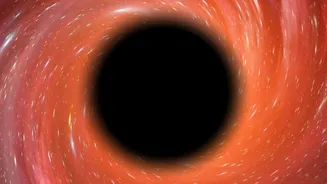
The results were stunning. Researchers identified more than 40 distinct spectral signatures that all pointed to one conclusion: GLIMPSE-17775 is an actively growing supermassive black hole enveloped in a thick, dense cocoon of gas and dust. This model, sometimes called a 'black hole star,' perfectly explains its appearance. The intense radiation from material spiraling into the black hole is absorbed by the surrounding shroud of gas. This cocoon then heats up and re-radiates the energy at longer, redder wavelengths, creating the signature 'little red dot' that Webb detects. According to the research team, the evidence was like assembling a mosaic; individual pieces of data came together to reveal a clear and coherent picture of a feeding black hole in its infancy.
Solving an Impossible Problem
This discovery has profound implications for one of the biggest questions in cosmology: how did supermassive black holes get so big, so fast? The black holes we see at the centers of galaxies today are millions or even billions of times the mass of our sun. Yet, JWST has found similarly massive black holes in the very early universe, when there seemingly wasn't enough time for them to grow so large through conventional means. The 'black hole star' model provides a potential solution. By being cocooned in a dense supply of gas, these early black holes could have fed voraciously and grown at an accelerated rate, far faster than previously thought possible. We may be looking at the long-sought-after 'baby pictures' of the galactic monsters that now dominate the cosmos.
The Life Cycle of a Red Dot
The finding also helps explain why LRDs seem to disappear from view as the universe gets older. Rather than vanishing, they likely just evolve. This cocooned phase may be a temporary, messy, and rapid stage of growth. Once the black hole consumes its immediate gas supply or the intensity of its own energy blows the cocoon away, it would begin to look like a more familiar active galactic nucleus, or AGN. Researchers have also found evidence that GLIMPSE-17775 is surrounded by a larger host galaxy. This suggests that as the black hole grows, the galaxy around it grows too, eventually transforming from a strange red dot into a sprawling galaxy similar to the ones we see in the universe today.