

Why Water Is the Ultimate Clue
On Earth, no known life can exist without liquid water. It is a universal solvent, capable of dissolving substances and facilitating the chemical reactions that are fundamental to biology. Water remains liquid across a wide range of temperatures, which
helps protect organisms from drastic climate shifts. Its unique property of being less dense as a solid—which is why ice floats—allows aquatic life to survive in frozen-over lakes and seas. For these reasons, astrobiologists believe that finding liquid water is the most promising first step in identifying environments that could potentially harbour life. While life might exist based on other chemistries, searching for water gives us a concrete, detectable target in our quest to know if we are alone in the universe.
The Cosmic Detective's Toolkit
Scientists can't just look through a telescope and see oceans on distant worlds. Instead, they rely on a sophisticated toolkit of indirect methods. One of the most powerful is spectroscopy. When a planet passes in front of its star, the starlight filters through the planet's atmosphere. By analyzing the spectrum of this light, scientists can spot the unique chemical 'barcode' or absorption lines that water vapour leaves behind. The James Webb Space Telescope excels at this, having detected water in the atmospheres of exoplanets over a thousand light-years away. For worlds closer to home, scientists use different tools. Radar instruments, like the one on the Europa Clipper mission, can penetrate icy crusts to look for evidence of subsurface oceans. We can also analyze the wobble in a moon’s rotation or measure its magnetic field to infer the presence of a vast, hidden body of liquid.
Prime Suspects in Our Solar System
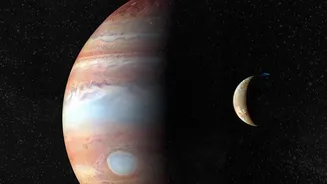
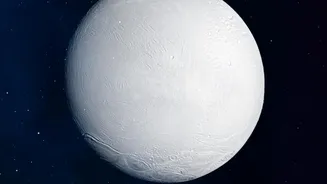
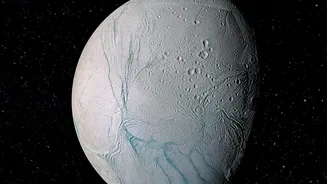
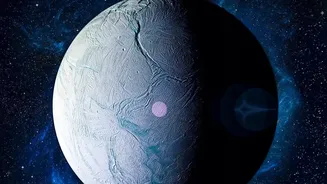
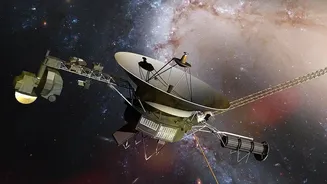
Our own solar system has several exciting candidates for liquid water. Mars is a primary focus. Evidence from rovers and orbiters shows that the Red Planet once had rivers and possibly oceans. While the surface is now a dry desert, recent analyses of seismic data from the InSight lander suggest that much of this ancient water may now be locked away in vast reserves deep underground. Farther out, the moons of Jupiter and Saturn are even more tantalizing. Jupiter's moon Europa is believed to hide a global saltwater ocean beneath its icy shell that may contain twice as much water as all of Earth's oceans combined. Saturn's moon Enceladus is also a prime target, famously shooting massive plumes of water vapour and ice particles into space from geysers on its surface. The Cassini spacecraft flew through these plumes, confirming they contain saltwater and organic molecules—key ingredients for life.
Hunting for Water in Distant Skies
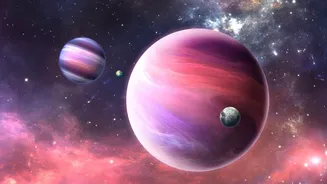
The search extends far beyond our cosmic neighbourhood. Using powerful instruments like the James Webb Space Telescope (JWST), astronomers are beginning to characterize the atmospheres of exoplanets—planets orbiting other stars. The JWST has already confirmed the presence of water vapour in the skies of hot, Jupiter-sized planets and even in the planet-forming disks of young stars, suggesting the ingredients for water-rich worlds are common throughout the galaxy. Recently, a new technique has been proposed to identify habitable worlds by comparing carbon dioxide levels between neighbouring planets; a significant drop could imply the gas is being absorbed by a liquid water ocean. While detecting an Earth-like ocean on a rocky exoplanet remains a monumental challenge, these early findings represent a giant leap forward in the quest to find a world that looks and feels like our own.