


A Historic Mission to the Hidden Side
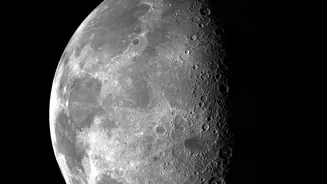
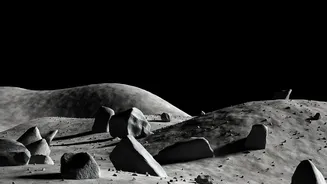
Until recently, our understanding of the Moon's geology was completely one-sided. Every sample returned by the American Apollo and Soviet Luna missions came from the near side, the hemisphere perpetually facing Earth. This left a huge gap in our knowledge,
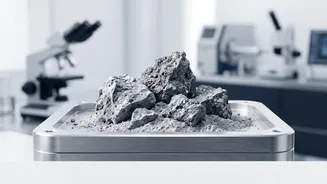
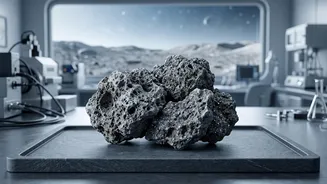
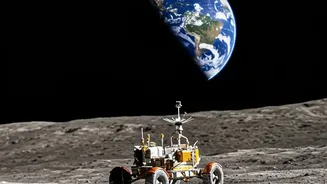
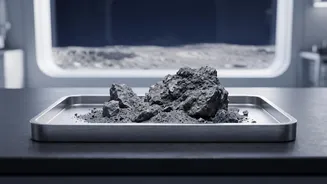
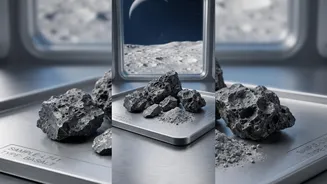
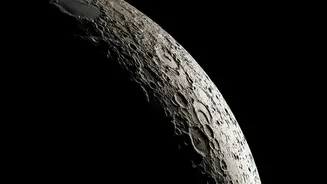
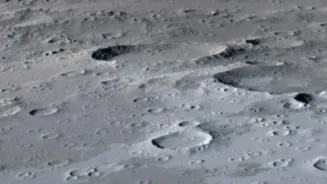
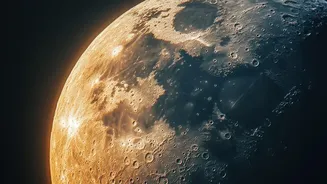
as orbital probes revealed the far side was dramatically different: its crust is thicker and it lacks the vast, dark lava plains, or 'maria', that form the 'Man in the Moon' on the near side. China's Chang'e-6 mission, which landed in the South Pole-Aitken (SPA) Basin in June 2024, changed everything. It successfully collected nearly two kilograms of rock and soil and returned them to Earth, marking the first time humanity has ever had physical material from the Moon's mysterious other half.
What the Rocks Revealed
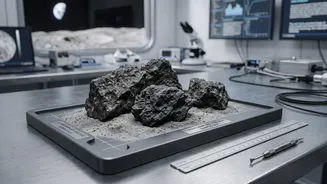
The samples, scooped from within the oldest and largest impact crater in the solar system, contained a diverse mix of materials. Crucially, scientists identified fragments of basalt, a type of volcanic rock. Analysis revealed evidence of at least two distinct periods of volcanic activity. Some rock fragments were dated to 4.2 billion years ago, while others were much younger at 2.8 billion years old. This proves that the far side, like the near side, had a long history of volcanism, with activity spanning at least 1.4 billion years. The composition of these two basalt types was also different, suggesting they came from separate magma sources within the lunar mantle.
Solving the Mystery of the Two Faces
So why do the two sides look so different if they both had volcanoes? The Chang'e-6 samples provide a compelling new theory. While the mantle deep below both hemispheres appears chemically similar, the crust and the distribution of certain elements are lopsided. One study published in late 2026 suggests the answer lies in the Earth's gravity. Billions of years ago, when the newly formed Moon was still a ball of molten rock, it became tidally locked with Earth. The immense gravitational pull from our planet could have generated more heat on the near side, driving huge currents in the magma ocean. This massive flow might have pushed lighter crustal materials toward the far side, making its crust thicker, while concentrating the heat-producing radioactive elements that fuelled long-lasting volcanism on the near side.
A Drier, Altered Mantle
The findings go even deeper, suggesting the colossal impact that formed the South Pole-Aitken Basin itself profoundly altered the far side. Analysis shows the mantle beneath the far side is significantly depleted in water compared to the near side. The same massive impact may have also 'cooked' the deep mantle, causing volatile elements like potassium to escape. Far side rocks have a higher proportion of a heavier potassium isotope, which researchers believe is a chemical scar left by the lighter isotope being boiled away in the extreme heat of the impact. This loss of water and other volatiles could have suppressed later volcanic activity on the far side, contributing to its different appearance today.