



From Finding Planets to Reading Them
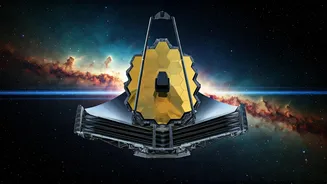
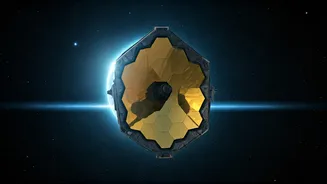
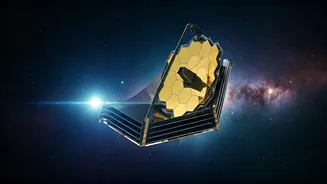
The James Webb Space Telescope has truly opened a new chapter in astronomy. It's no longer just about detecting a tell-tale dip in a star's light to prove a planet exists. JWST is designed to read the story written in that light. By using a technique
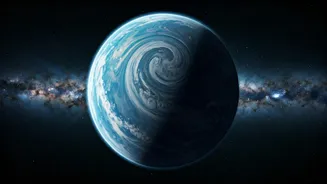
called transit spectroscopy, the telescope analyzes the tiny fraction of starlight that filters through an exoplanet's atmosphere as it passes in front of its host star. Different molecules in the atmosphere absorb light at specific wavelengths, leaving a unique chemical fingerprint. This allows astronomers to deconstruct the atmosphere of a world light-years away, identifying gases like water vapor, methane, and carbon dioxide. It is a revolutionary leap that has been described as starting a new era in exoplanet research.
A Glimpse of a Planet's Fate
A recent study published on July 1, 2026, showcases this new capability by looking at a planet named WD 1856 b, a Jupiter-sized world orbiting a white dwarf—the dead remnant of a Sun-like star. This planet is an enigma; it orbits its dead star so closely it should have been destroyed when the star expanded into a red giant. Using JWST, astronomers measured its temperature and atmospheric composition, discovering signs of methane and that the planet was significantly warmer than expected. The data suggests that after its star died, the planet migrated inward, with the white dwarf's immense gravity flexing and squeezing it, generating internal heat. This provides a fascinating, and somewhat unnerving, glimpse into the possible future of our own solar system.
The Search for 'Biosignatures'
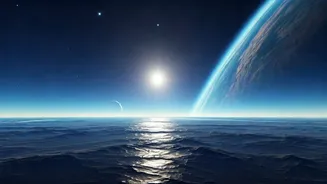
The ultimate goal for many is to find 'biosignatures'—chemicals in an atmosphere that could indicate the presence of life. On Earth, for instance, a molecule called dimethyl sulfide (DMS) is produced almost exclusively by marine life. Astronomers using JWST have found tantalizing hints of DMS in the atmosphere of K2-18b, a 'Hycean' planet (a hot, ocean-covered world) 124 light-years away. While the finding is not yet definitive, it represents one of the strongest hints of potential biological activity found to date. However, scientists are cautious. The task is complex, and what might look like a biosignature could be produced by an unknown geological or chemical process. JWST's data is forcing astronomers to refine their models and acknowledge that they may not find a single "silver bullet" gas that screams 'life.'
A New Toolkit, A New Reality
JWST isn't just confirming old theories; it's revealing a universe far stranger than imagined and challenging existing models of how planets form and evolve. For example, recent observations helped solve the mystery of the 'Pink Planet,' GJ 504 b, revealing it has clouds made of salt. In another system, the telescope is being used to investigate 'super-puff' planets with the density of cotton candy. But the telescope has also delivered humbling results. Several Earth-sized planets orbiting M-dwarf stars, once considered prime targets, have been found to have no atmosphere at all, likely stripped away by their volatile stars. This is a crucial finding that reshapes the search, steering astronomers toward different kinds of stars and planets. Each observation, whether it's of a bizarre atmosphere or no atmosphere at all, provides a vital data point that helps astronomers build a more complete picture of the galaxy.