


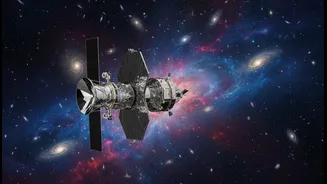
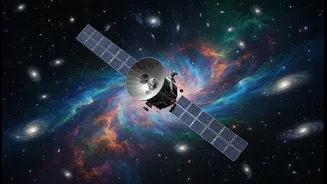


Meet the 'Mother of Hubble's' Successor
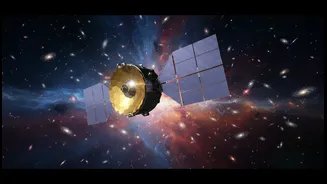
The telescope is named after Dr. Nancy Grace Roman, NASA’s first chief of astronomy and a trailblazing executive often called the 'Mother of the Hubble Space Telescope' for her pivotal role in making it a reality. Dr. Roman, who passed away in 2018, was
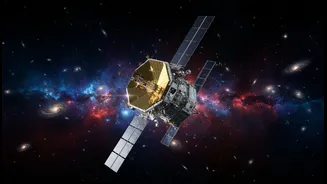
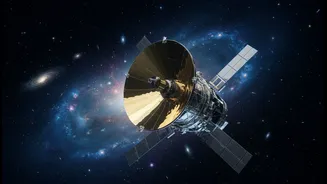
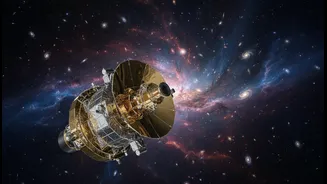
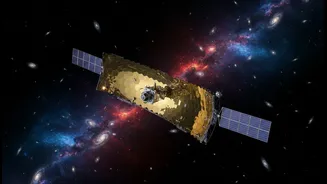
a relentless advocate for space-based observatories and championed women in science throughout her career. The Roman Space Telescope, scheduled for launch on August 30, 2026, aboard a SpaceX Falcon Heavy, honours her legacy by pushing the boundaries of cosmic exploration. While it has the same-sized 2.4-meter primary mirror as Hubble, its capabilities are vastly different and designed for a new era of discovery.
A Panoramic View of the Universe
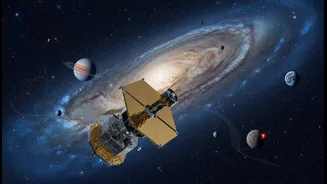
The single greatest advantage of the Roman Telescope is its extraordinary field of view. Its Wide Field Instrument can capture an area of the sky at least 100 times larger than Hubble’s infrared camera in a single shot, all with the same stunning clarity. Imagine swapping a keyhole view for a giant panoramic window. While it took Hubble over 400 separate images to map a significant portion of the nearby Andromeda Galaxy, Roman could do it in just two. This 'big picture' capability will allow it to conduct massive surveys of the sky with incredible efficiency, mapping billions of galaxies and stars to create unprecedented statistical maps of the cosmos. It’s a transition from studying individual trees to mapping the entire forest.
Hunting for the Universe's Biggest Mysteries
About 95% of the universe is made of enigmatic substances called dark matter and dark energy, which science cannot yet explain. Dark energy is the force causing the universe's expansion to accelerate, and Roman's primary mission is to investigate it. It will do this in three key ways: by mapping the distribution of galaxies to see how dark energy has shaped the cosmic web, by observing thousands of distant exploding stars (supernovae) to measure cosmic distances, and by studying how the gravity of massive objects subtly bends the light from distant galaxies, a technique called weak gravitational lensing. These observations will provide the most precise measurements yet of how cosmic expansion has changed over time, giving crucial clues to the nature of this mysterious force.
A Census of a Hundred Thousand New Worlds
Beyond cosmology, Roman is set to revolutionise the hunt for exoplanets—planets orbiting other stars. While missions like Kepler found thousands of planets by watching for the dip in starlight as a planet passes in front, Roman will primarily use a different technique called gravitational microlensing. This method, predicted by Einstein, occurs when a star and its planet pass in front of a more distant star. Their combined gravity acts like a lens, momentarily magnifying the background star's light. This technique is sensitive enough to find planets far from their stars, planets as small as Mars, and even 'rogue planets' that wander through the galaxy without a parent star. Scientists predict Roman could discover around 100,000 new exoplanets, vastly expanding our catalogue of known worlds.
A New Partner in Space
Roman is not a replacement for the Hubble or James Webb Space Telescopes but a powerful partner. While Webb excels at deep, narrow-field observations of specific targets, Roman’s strength is its ability to survey huge areas quickly. It will identify countless new targets—from intriguing galaxies to unusual stars—that Webb and other telescopes can then study in greater detail. Additionally, Roman is equipped with a technology demonstrator called a Coronagraph Instrument, designed to block the intense glare from a star to directly image the planets orbiting it. This is a crucial step toward one day taking pictures of Earth-like planets around other stars and analysing their atmospheres for signs of life.