


The Rise of the Creative Machine
Generative AI tools have taken the world by storm, producing content that is often indistinguishable from, and sometimes even superior to, that of an average person. Platforms like DALL-E and ChatGPT can generate complex images from text prompts and write
coherent stories, demonstrating a remarkable ability to synthesise and recombine information from vast datasets. This has led some to believe that AI is on the verge of matching human creativity. However, what these systems are doing is more akin to sophisticated pattern recognition and mimicry rather than genuine creation. They learn from millions of existing works and generate new content based on those learned patterns. This process, while impressive, lacks the spark of true originality.
The Lived Experience and Empathy Gap
The most significant advantage humans have is our lived experience. Our creativity is not born in a vacuum; it is shaped by our emotions, our relationships, our struggles, and our triumphs. An artist's pain, a musician's joy, a writer's longing—these are the raw materials of human creativity. AI has no life to live, no emotions to feel, and no consciousness to grapple with existence. It cannot understand the cultural context or the emotional nuances that give art its meaning and resonance. A recent study confirmed that even when AI produces images, it performs poorly without human guidance, precisely because it lacks this foundation of experience. Art created by humans is consistently rated as more skillful and valuable because we perceive it as being infused with the artist's unique perspective and emotional depth.
Originality vs. Sophisticated Remixing
Is AI truly creating, or is it just performing an advanced form of remixing? Many experts argue for the latter. AI models are trained on existing data, and their outputs are fundamentally bound by that data. They can create novel combinations, but they cannot invent something entirely new, something that was not implicitly present in their training. Human creativity, on the other hand, involves breaking rules and thinking outside the box. We can connect disparate ideas, draw on intuition, and have 'aha' moments that lead to genuine breakthroughs. While AI can enhance the creativity of less creative people, it tends to make outputs more homogeneous, potentially stifling the kind of diverse, breakthrough thinking that drives innovation. True originality comes from a place of intentionality and a desire to express something unique, which AI currently lacks.
The Power of Intentionality
Behind every great work of human art is an intention. An artist chooses their medium, a writer chooses their words, and a composer chooses their notes, all with a specific purpose in mind—to communicate an idea, evoke an emotion, or tell a story. This intentionality is a driving force of creativity that is absent in AI. AI responds to prompts; it does not have its own desires or motivations to create. It does not get 'artist's block', but it also doesn't feel the burning need to express an inner truth. The creative process for a human is often a journey of discovery, where the concept takes shape as the creator interacts with their materials. AI's process, by contrast, is a direct execution of a command, a straight line from prompt to product.
A Future of Collaboration
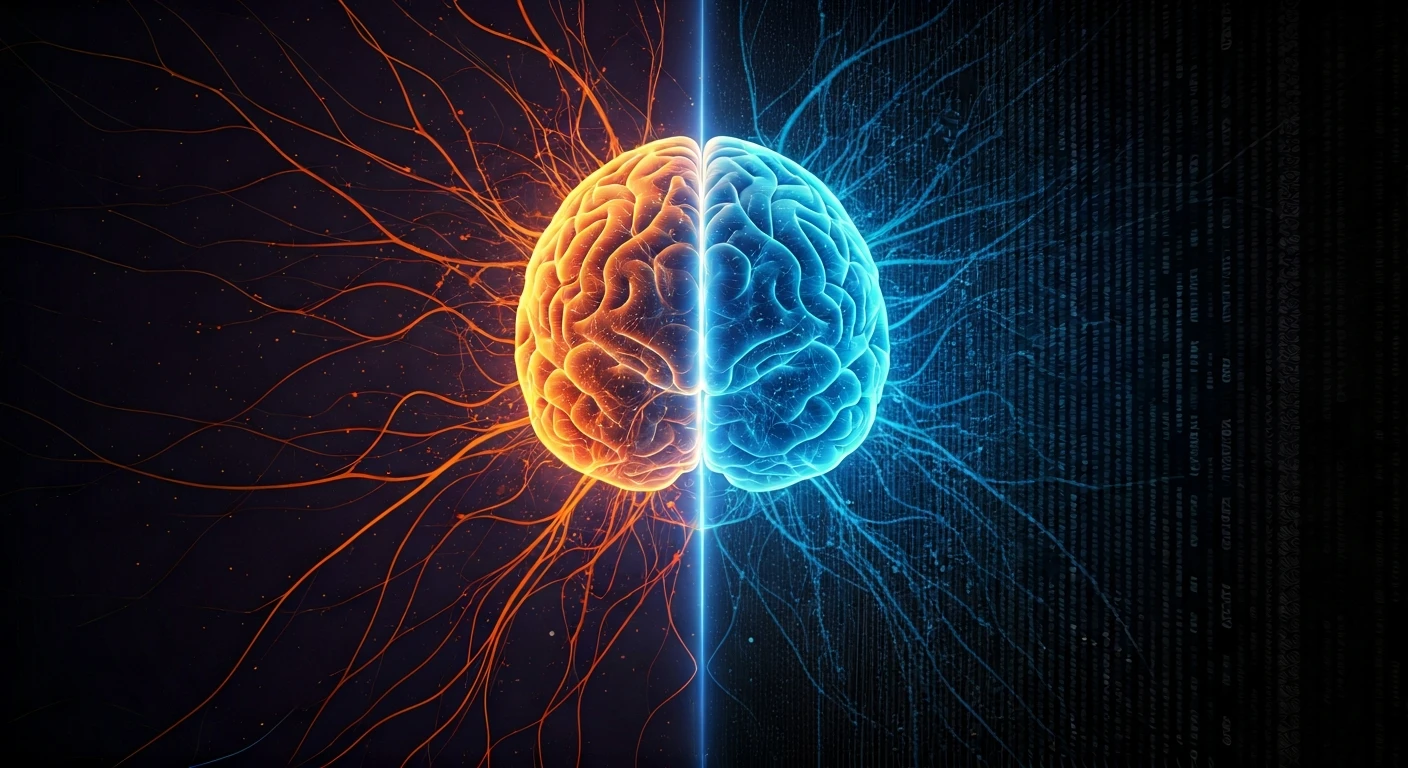
Rather than replacing humans, the future of creativity is likely to be a collaboration between man and machine. AI can be an incredibly powerful tool for artists, writers, and designers. It can automate repetitive tasks, generate a wide range of ideas to build upon, and help creators explore new possibilities. In this partnership, the human provides the vision, the emotional depth, and the critical judgment, while the AI provides the computational power and the raw material. The most successful AI-assisted art will likely be that which maintains a clear human intentionality, using technology to enhance, not outsource, the creative vision. This collaborative approach can democratize creativity, empowering more people to bring their ideas to life while preserving the irreplaceable value of the human touch.