





The Junkyard Above Our Heads
Since the launch of Sputnik 1 in 1957, humanity has been sending rockets and satellites into orbit. But for every active satellite providing GPS, weather data, or internet, there are defunct satellites and discarded rocket stages. Worse, there are millions
of smaller fragments from accidental collisions and explosions. According to the European Space Agency, there are over 34,000 pieces of debris larger than 10 centimeters being tracked. These objects travel at incredible speeds, up to 28,000 kilometers per hour. At that velocity, even a tiny paint fleck can cause significant damage to an operational satellite or a crewed spacecraft. This growing cloud of debris raises the frightening possibility of the Kessler Syndrome, a theoretical scenario where the density of objects in orbit becomes so high that collisions create a cascade of more debris, rendering space unusable for generations.
Enter the Laser Harpoon
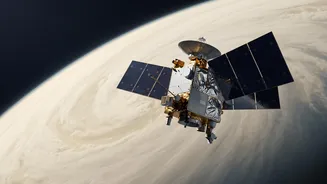
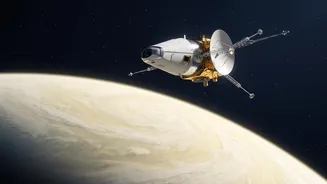
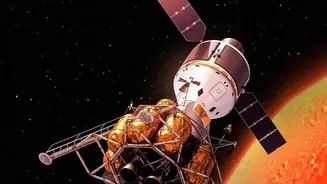
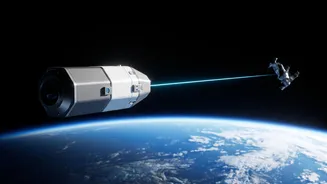
Cleaning up this high-speed junkyard requires a unique set of tools. Among the most promising are active debris removal (ADR) systems that use harpoons, often guided by lasers. A mission like the one demonstrated by the RemoveDEBRIS project gives us a glimpse of how this works. A 'chaser' spacecraft would first rendezvous with a piece of large debris, like a dead satellite. It then uses advanced vision-based navigation, sometimes involving LiDAR, to analyze the target's rotation and trajectory. Once it has a lock, it fires a penetrating harpoon tethered to the chaser. After a successful capture, the chaser can then use its own engines to drag the combined mass into a lower orbit, where it will safely burn up upon reentering Earth's atmosphere. The 'laser' component can be used for precise targeting or, in other concepts, to ablate the surface of debris to create a small amount of thrust, stabilizing it before capture.
The New Space Janitors
A new commercial sector is emerging to tackle this problem, turning orbital cleanup into a viable business. The European Space Agency (ESA) has been a major driver, funding studies and missions like e.Deorbit and ClearSpace-1, which will be one of the first missions to remove a piece of debris from orbit. Companies like the Swiss startup ClearSpace, Japan's Astroscale, and aerospace giant Airbus are all developing technologies for observing, capturing, and deorbiting space junk. Astroscale has focused on systems including magnetic capture, while Airbus was a key partner in the successful RemoveDEBRIS mission that tested both net and harpoon technologies. These efforts are creating a new market for in-orbit servicing, where companies can offer cleanup services to satellite operators and governments concerned about protecting their valuable assets in space.
Hurdles Before the Hunt
Despite the promising technology, significant challenges remain. Active debris removal is incredibly complex and expensive, with a single mission costing hundreds of millions of dollars. There are also tricky legal questions: who is responsible for derelict satellites, and who has the right to touch or remove them? A failed capture attempt could accidentally create even more debris, making the problem worse. Furthermore, the technology for autonomously approaching and grappling with a tumbling, non-cooperative object is still being perfected. Human-in-the-loop control is often not feasible due to communication delays. These technical, financial, and legal hurdles must be overcome before harpoon-wielding satellites can become the routine orbital cleanup crew we need.