




The 'Goldilocks' Standard
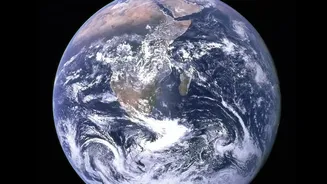
When scientists search for potentially habitable planets, they start with a simple concept learned from Earth: the 'Goldilocks' principle. Our planet orbits the Sun at a distance that is not too hot and not too cold, but just right for liquid water to exist
on its surface. This region around a star is called the habitable zone. While water is plentiful throughout the solar system in the form of ice and vapor, Earth is the only place we know of with stable bodies of liquid water, like oceans and lakes. This is critical because water is a universal solvent, capable of dissolving other substances and facilitating the complex chemical reactions that are essential for life as we know it. Therefore, the first filter in the search for life elsewhere is finding rocky planets within their star's habitable zone.
An Atmosphere That Breathes
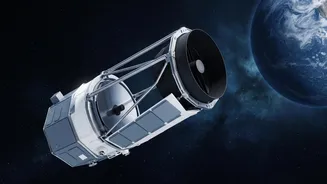
A planet in the right place is just the start; it also needs the right kind of atmosphere. Earth's atmosphere does more than just provide air to breathe; it acts as an insulating blanket, trapping heat to keep temperatures stable. It also shields the surface from harmful solar radiation. More importantly, the composition of our atmosphere is a flashing sign that life is here. The high concentration of oxygen is a direct result of biological activity—specifically, photosynthesis. Oxygen is highly reactive, so its continued presence means something is constantly replenishing it. Scientists call this a 'biosignature'—a feature that provides evidence of past or present life. When telescopes like the James Webb Space Telescope analyze the atmospheres of distant exoplanets, they are searching for similar chemical imbalances that could signal a living world.
Lessons from a Changing World
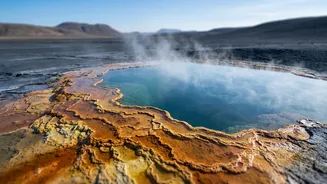
Earth hasn't always looked the way it does today. For billions of years, life was purely microbial, and the atmosphere was devoid of oxygen. This history teaches astrobiologists a crucial lesson: life doesn't have to be complex or intelligent to be detectable. The search for life includes looking for biosignatures from simple organisms. For example, microbes can produce gases like methane, and a combination of methane and oxygen in an atmosphere is a strong indicator of biological processes. Earth’s different geological eras, with their varying climates and atmospheric compositions, provide multiple templates for what a living planet could look like at different stages of its evolution. This allows scientists to widen their search beyond just looking for an 'Earth 2.0' and instead consider planets that might resemble Earth's past.
The Planet's Inner Engine
A planet’s habitability is also influenced by what happens beneath its surface. Earth is geologically active, with a hot core that drives processes like plate tectonics and volcanism. Plate tectonics are crucial for regulating our planet's climate over long timescales by cycling carbon between the atmosphere, oceans, and rocky crust. This global recycling prevents a runaway greenhouse effect like the one on Venus or the thin, cold atmosphere of Mars. Volcanic activity also releases gases that help maintain the atmosphere and transports nutrients essential for life to the surface. This internal heat engine keeps the planet's environment stable, a key feature that scientists now consider when assessing the potential habitability of other rocky worlds.
Beyond Biology: A Search for Technology
Using Earth as a baseline also extends to the search for intelligent life. Just as living organisms alter their environment, advanced civilizations might leave their own detectable traces, known as 'technosignatures'. These could range from artificial radio or laser signals to the presence of industrial pollutants like nitrogen dioxide in a planet's atmosphere. Other hypothetical signs include massive structures built to harvest a star's energy, sometimes called Dyson spheres. By considering the byproducts of our own technological society, scientists can brainstorm what to look for when searching for civilizations beyond our own. This branch of astrobiology is growing, applying the principle that technology, like life itself, can have a planet-altering impact.