




What is a Nebula?
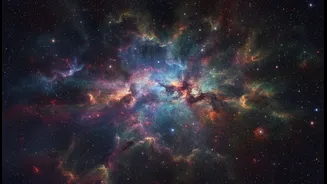
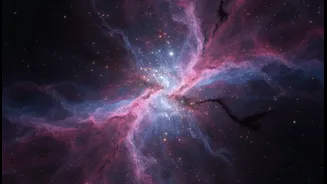
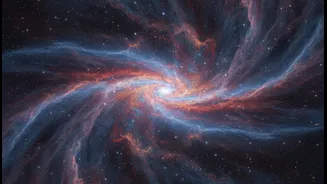
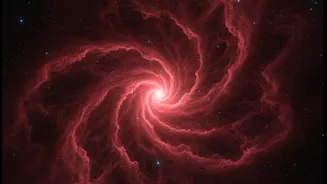
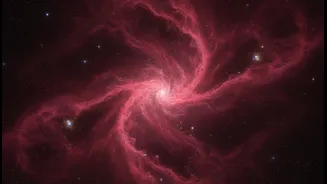
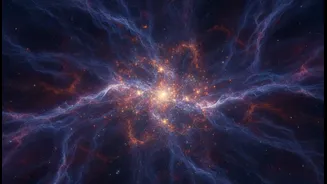
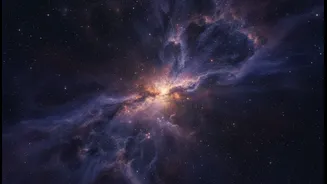
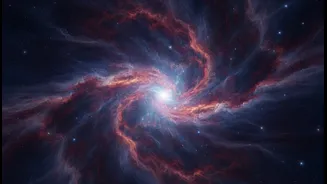
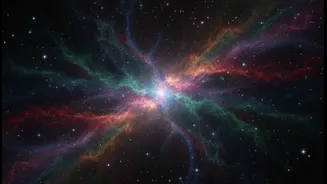
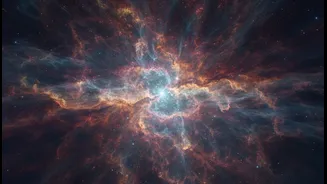
The word 'nebula' is Latin for 'cloud', an apt description for these vast interstellar structures. They are composed primarily of hydrogen and helium, the most abundant elements in the universe, along with traces of other elements and cosmic dust. These
clouds of gas and dust are part of the interstellar medium, the incredibly diffuse material that fills the space between stars. While this medium is generally thin, in certain regions, gravity causes the gas and dust to clump together, forming the dense clouds we recognize as nebulae, some of which can span hundreds of light-years.
The Recipe for a New Star
Star formation begins inside the coldest, densest types of nebulae, often called molecular clouds. Think of it as a cosmic recipe. The primary ingredients are simple: huge amounts of hydrogen gas and dust. For the process to begin, something needs to give gravity a helping hand. This trigger can be a disturbance, like the shockwave from a nearby supernova (an exploding star) or the gravitational pull from a passing star, which causes a region of the cloud to become unstable and start collapsing.
From Cloud to Fiery Core
As gravity pulls the gas and dust inward, the material gathers into a dense, spinning clump. This clump, known as a core, continues to attract more matter, increasing its mass, pressure, and temperature. As the core collapses, it heats up due to friction and compression, much like air in a bicycle pump gets hot when compressed. This hot, dense, and glowing core is called a protostar. At this stage, it shines not from nuclear fusion but from the heat generated by its own gravitational contraction. These infant stars are often shrouded in the dense dust of the nebula, making them difficult to see in visible light but detectable in the infrared spectrum.
A Star Is Born
The protostar phase can last for millions of years. As the protostar continues to accumulate mass, the pressure and temperature at its core build to extreme levels. Eventually, it becomes so hot—reaching about 10 million degrees Kelvin—that nuclear fusion ignites. This is the momentous event where hydrogen atoms begin to fuse together to form helium, releasing an enormous amount of energy. This outward rush of energy finally balances the inward pull of gravity, stabilizing the new star. The protostar has now become a true, stable star, entering what is known as its main sequence, the longest phase of its life.
A Gallery of Cosmic Cradles
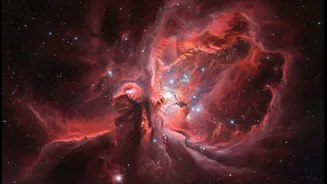
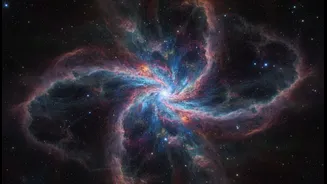
Some of the most iconic images captured by telescopes like Hubble and the James Webb Space Telescope are of these star-forming regions. The Orion Nebula, a bright nebula visible to the naked eye, is the closest massive star-forming region to Earth. Another famous example is the Eagle Nebula, which contains the spectacular 'Pillars of Creation'—towering columns of gas and dust where new stars are actively forming. Others, like the Carina Nebula, are home to some of the most massive and luminous stars known. These nebulae are not just beautiful; they are active laboratories that allow astronomers to study the stellar life cycle in real-time.
The Aftermath of Birth
Once new stars form, their intense radiation and powerful stellar winds begin to blow away the surrounding gas and dust. This process carves out cavities within the nebula and can even trigger the collapse of nearby gas clouds, setting off a new wave of star formation in a cosmic chain reaction. The material left over in the spinning disk around a young star doesn't go to waste; it can eventually clump together to form planets, asteroids, and comets. In this way, the same cloud that gives birth to a star also provides the raw materials for its future solar system.