

A Threat from the Sun
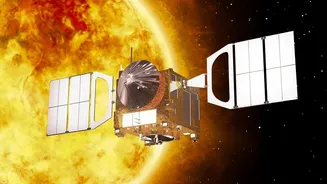
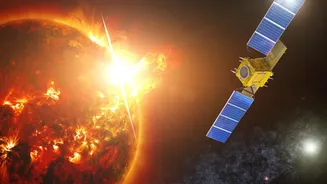
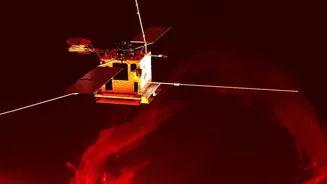
An extreme space event, often called a solar superstorm, occurs when the Sun releases a massive burst of energy and highly charged particles, known as a coronal mass ejection (CME). If a powerful CME is aimed at Earth, it can violently interact with our
planet's magnetic field, triggering a severe geomagnetic storm. While Earth's atmosphere protects us on the ground, satellites orbiting above are highly exposed. The most famous example is the 1859 Carrington Event, which was so powerful it set telegraph stations on fire. While that technology was simple, a similar event today would pose a catastrophic threat to our complex, interconnected technological society.
How Satellites Fail
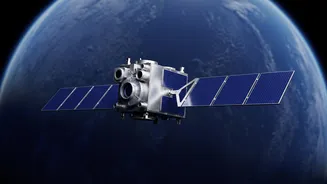
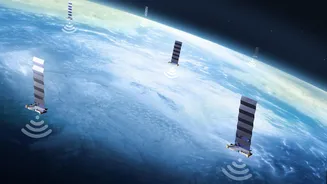
Recent studies and real-world events have shown how vulnerable satellites are. During a geomagnetic storm, the Earth's upper atmosphere heats up and expands, increasing the density of the air in low-Earth orbit (LEO). This creates significantly more atmospheric drag on satellites, causing them to slow down and lose altitude. In a dramatic example from February 2022, a relatively moderate storm caused increased drag that resulted in the loss of up to 40 newly launched Starlink satellites, which were unable to overcome the friction and re-entered the atmosphere. Beyond drag, intense solar radiation can damage sensitive electronics, degrade solar panels, and cause 'phantom commands' that disrupt satellite operations. Over time, this radiation damage accumulates, potentially shortening the lifespan of entire satellite constellations.
Modelling a Cascade of Failure
The latest research uses complex computer models to simulate the potential impact of an extreme event. These models show that the failure wouldn't be isolated. During the major solar storm of May 2024, researchers observed a 'W-pattern' of impact across the Starlink constellation, where satellites directly facing the sun experienced more drag and altitude loss. This led to cascading adjustments as the automated system tried to compensate, propagating delays and latency across the network even after the storm's peak. Other studies have modelled even more severe scenarios. One recent analysis of a hypothetical nuclear detonation in space—which also creates an extreme radiation environment—projected that 98% of satellites in LEO could be disabled within a week, leading to a surge in orbital collisions. While a solar storm is different, the underlying principle of cascading failure across a dense network holds true.
The Domino Effect on Earth
The failure of satellite systems would have immediate and severe consequences for the global economy. Global Navigation Satellite Systems (GNSS), like GPS, are foundational not just for maps, but for timing and synchronisation. Financial markets, mobile networks, and even power grids rely on this precise timing. A widespread outage would disrupt these systems, potentially leading to errors in banking transactions and power failures. Aviation and maritime logistics would be crippled. A European Space Agency study estimated that a one-week loss of satellite communications would cost the aviation and maritime sectors over €9.9 billion combined, disrupting thousands of flights and halting shipping operations. In India, where digital infrastructure from UPI to logistics is rapidly expanding, the reliance on satellite-derived data makes the economy particularly vulnerable to such a disruption.
Building a More Resilient Sky
The risk of a Carrington-level event in any given decade is estimated to be as high as 12%. Given the stakes, researchers and space agencies are focused on building resilience. This includes developing better space weather forecasting models, like the MAGE supercomputer model, to provide earlier warnings. With advanced notice, operators can take protective measures, such as placing satellites into a 'safe mode' or adjusting their orbits to minimise drag. Other strategies include building more robust satellites with hardened electronics and greater redundancy. However, there is a constant tension between cost and resilience. Understanding that even moderate, longer-lasting storms can have a significant cumulative impact is shifting the focus from just surviving a single, giant blast to enduring a more hostile space environment over the long term.