


The Challenge of a Water Landing
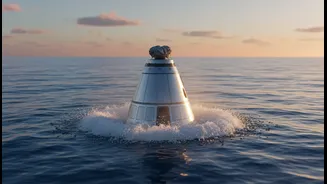
Hitting the water at over 30 kilometers per hour might sound gentle compared to re-entry speeds, but for a returning crew capsule, it's a moment of immense physical stress. A water landing is not a trivial event; it is a complex fluid-impact problem.
The forces experienced during these final seconds can determine the design of more than half of the spacecraft's structure. Engineers must account for not just the impact itself, but a dozen other variables: the angle of entry, the wind speed, the height and pattern of ocean waves, and even what happens if one of the main parachutes fails to open. The ultimate goal is to manage this violent encounter with the ocean surface to ensure the structural integrity of the capsule and, most importantly, the safety of the astronauts inside.
Starting in the Digital World
Long before any hardware gets wet, the splashdown process begins inside a computer. Engineers use powerful software to create high-fidelity simulations, primarily through a method called Computational Fluid Dynamics (CFD). CFD allows them to model how the water will behave as the capsule strikes it, predicting pressures and forces with incredible detail. These digital models are the first line of defense, allowing teams to run through hundreds of scenarios without the expense of physical tests. They can simulate different impact angles, velocities, and sea states to identify the most stressful potential landings. While incredibly powerful, these computer models have limitations and need to be validated against real-world data.
From Models to Mockups
This is where the digital world meets the physical. To verify the computer simulations are accurate, engineers build mockups of the spacecraft, often called boilerplate test articles. These are not hollow shells; they are carefully weighted and balanced replicas of the real capsule. In facilities like NASA's Hydro Impact Basin, a massive research pool, these mockups are dropped into the water again and again. Each test is designed to replicate a specific scenario identified in the CFD modeling, such as an off-nominal angle or a higher-than-expected descent speed due to a parachute failure. These tests provide the physical data needed to anchor and refine the computer models.
Gathering Millions of Data Points
A single drop test, which is over in seconds, can generate a staggering amount of information. The test capsules are covered in hundreds of sensors, including accelerometers, strain gauges, and pressure monitors. For NASA's Orion capsule tests, for example, sensors gathered over 10 million data points every second. This high-fidelity data provides a precise picture of the forces acting on every part of the structure. Engineers also place instrumented crash-test dummies inside the mockups to measure the forces the crew would experience, helping to refine seat designs and safety restraints. High-speed cameras capture the impact from multiple angles, allowing teams to correlate the sensor data with the capsule's actual physical motion.
Ensuring a Safe Finish
The entire process, from digital simulation to physical drop tests, is about reducing risk. By subjecting mockups to the most stressful conditions imaginable in a controlled environment, engineers can build a spacecraft that is ready for the unpredictable reality of the open ocean. They test for worst-case scenarios, like landings in rough seas or with malfunctioning equipment, to ensure the capsule can protect its crew. The data also helps improve post-splashdown systems, like the airbags that automatically inflate to keep the capsule upright in the water. This meticulous verification ensures that when astronauts return from the Moon or beyond, their final few feet of travel are as safe as the millions of miles that came before.