


A New Window to the Dawn of Time
Imagine trying to read the first page of a book from billions of kilometres away. That's the challenge astronomers face when studying the early universe. For the first few hundred million years after the Big Bang, the cosmos was a dark, foggy place, filled
with a neutral gas of hydrogen and helium. The birth of the very first stars and galaxies was the event that burned away this fog, a period known as the Cosmic Dawn. Until recently, observing this critical era was beyond our technological reach. But with the launch of the James Webb Space Telescope (JWST), that has changed dramatically. JWST is designed to see the universe in infrared light, which is invisible to the human eye. This allows it to capture the light from the most distant objects, whose light has been stretched into longer, redder wavelengths as the universe has expanded over 13 billion years. It's the ultimate time machine.
Discoveries That Defy Expectation
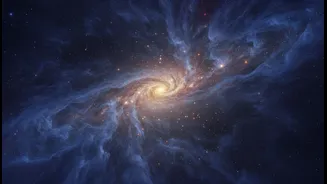
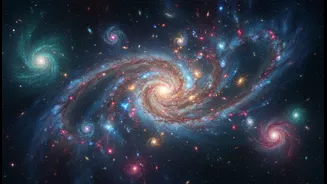
Standard cosmological models predicted that the first galaxies would be small, clumpy, and relatively simple. The idea was that these 'baby' galaxies would slowly merge and grow over billions of years into the grand spirals and ellipticals we see today. However, JWST's observations are revealing a far more complex and advanced early universe than anyone anticipated. Astronomers are finding galaxies that are surprisingly massive, bright, and structured far earlier than models suggested was possible. For instance, the JADES program has identified galaxies like JADES-GS-z14-0, which existed just 290 million years after the Big Bang, yet is astonishingly luminous and large for its age. This and other similar discoveries suggest that the process of galaxy formation was perhaps much faster and more efficient than previously thought.
The Puzzle of the 'Little Red Dots'
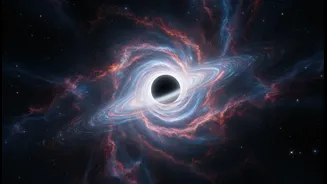
Among the most puzzling new discoveries are objects nicknamed 'little red dots'. These are compact, red-hued objects that appear to have been common around 600 million years after the Big Bang, only to fade away a billion years later. Initially, their nature was a complete mystery. However, recent studies suggest that many of these are not typical galaxies, but rather the glowing, gas-shrouded cores of rapidly growing supermassive black holes. This is another finding that challenges conventional wisdom. Supermassive black holes, some weighing millions to billions of times more than our sun, were not expected to exist in such numbers or at such sizes so early in cosmic history, raising profound questions about how these cosmic giants form and grow.
Building Blocks and Chemical Surprises
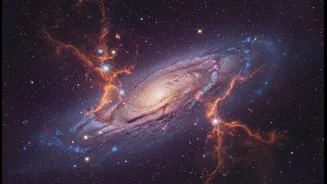
Beyond just size and brightness, JWST is revealing the chemical makeup of these ancient galaxies. Elements heavier than hydrogen and helium, which astronomers call 'metals', are forged inside stars and scattered through space when they die. Therefore, the oldest galaxies should be the most chemically primitive. While JWST has indeed found some galaxies with extremely low metal content, it has also found surprisingly mature chemical signatures in others. The detection of oxygen in a galaxy as distant as JADES-GS-z14-0 suggests that multiple generations of stars must have already lived and died within the first few hundred million years of the universe. Other discoveries include complex structures like rotating nuclear disks and stellar bars—features once thought to belong only to modern, mature galaxies—appearing just a few billion years after the Big Bang. This indicates that galaxies began organising themselves into complex systems far earlier than our models had accounted for.