







A Carefully Chosen Racetrack
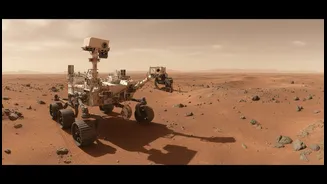
When NASA's Perseverance rover landed on Mars on February 18, 2021, it didn't just touch down in a random spot. Its landing site, Jezero Crater, was the result of years of debate and analysis. Scientists believe the 28-mile-wide crater was once a deep
lake fed by a river, forming a delta rich in sediments. On Earth, river deltas are exceptional at preserving signs of life. The hope was that Jezero’s delta might hold clues—or biosignatures—of ancient microbial life that may have existed on Mars billions of years ago when the planet was warmer and wetter. The entire mission was designed around this idea: land in a promising spot, explore its geology, and collect the most compelling rock samples for a potential future return to Earth.
The Long and Winding Road
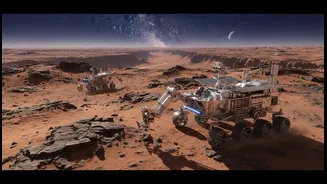
For over five years, Perseverance has been meticulously executing its mission. It explored the crater floor, confirming with ground-penetrating radar that the site was indeed a former lakebed with sedimentary deposits just like those on Earth. It then drove to the main event: the fan-shaped delta, where it spent months analyzing and drilling into layers of rock that were once fine mud at the bottom of a lake. This journey was never a sprint. Each movement was carefully planned, with the rover pausing to analyze its surroundings with a suite of complex instruments, zapping rocks with lasers, and drilling to collect pristine core samples. On June 14, 2026, after 1,890 Martian days of driving, the rover's odometer finally ticked over to 26.2 miles (42.2 kilometers)—a full marathon. It achieved this milestone in less than half the time it took the previous record-holder, the Opportunity rover, a testament to its advanced navigation capabilities.
A New Chapter Beyond the Finish Line
The marathon finish line isn't an end point but a major transition. The rover's long journey has taken it across the crater floor, up the delta, and now to an entirely new region: the crater rim. This is what makes the marathon a "timely story." Having thoroughly explored the lakebed deposits, Perseverance has begun its ascent of the crater's western rim, giving scientists access to a completely different type of geology. These rocks weren't deposited by the river; instead, they are ancient pieces of Martian crust that were violently uplifted by the asteroid impact that created Jezero Crater billions of years ago. By studying this area, scientists can look at rocks that are among the oldest in the solar system, offering a window into the planet's very formation and what primordial Mars—and even early Earth—might have looked like.
The Precious Cargo
Throughout its marathon journey, Perseverance has been collecting a unique set of souvenirs. To date, the rover has drilled and sealed dozens of rock and soil samples into special tubes. This collection is a geological library of Mars, containing everything from volcanic rock on the crater floor to fine-grained sedimentary mudstone from the delta, and now, ancient crustal rock from the rim. These samples are the centerpiece of the ambitious Mars Sample Return (MSR) campaign, a proposed joint mission between NASA and the European Space Agency (ESA) to one day send another spacecraft to Mars, retrieve the samples, and bring them back to Earth. While the MSR mission faces significant budget and scheduling challenges, the samples Perseverance is collecting remain the highest priority for planetary science. Analyzing them in advanced labs on Earth could revolutionize our understanding of Mars and finally answer the question of whether life ever existed there.