





The Return to the Moon Accelerates
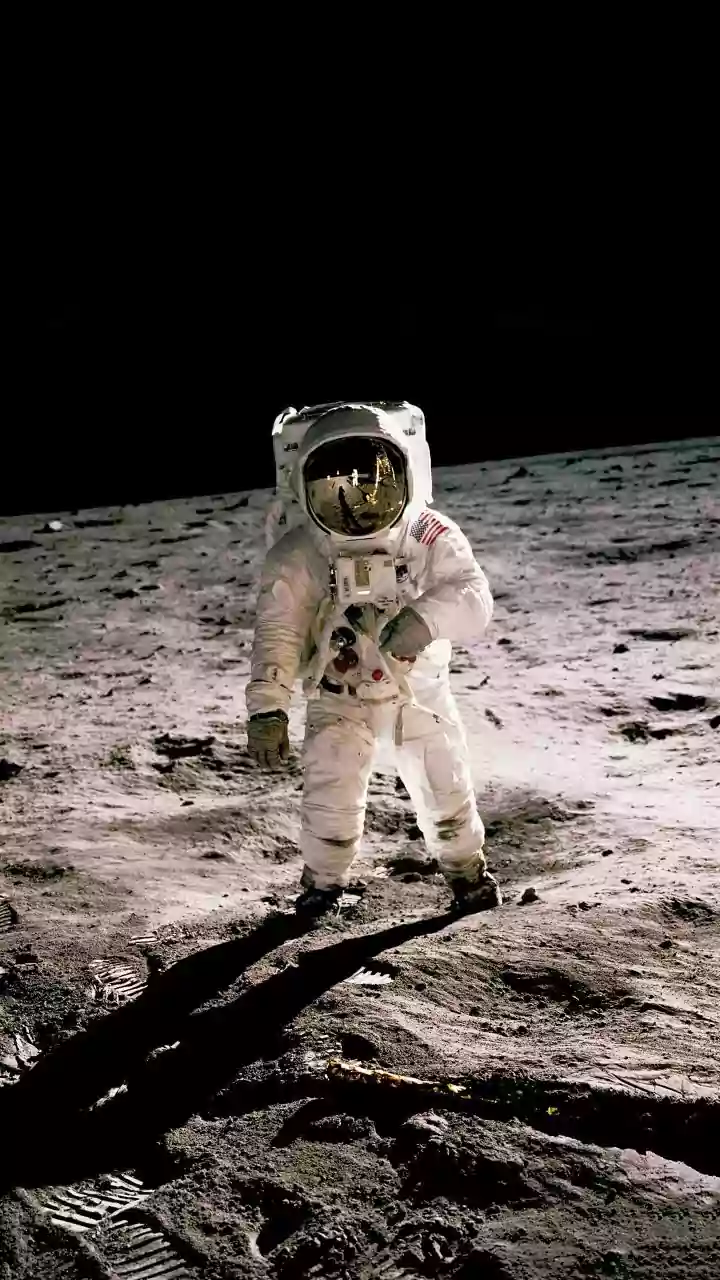
The Moon has once again captured the world's imagination, with the past year marking a critical period for NASA's Artemis program. The highlight was the Artemis II mission, which successfully sent four astronauts on a flyby of the Moon in April 2026,
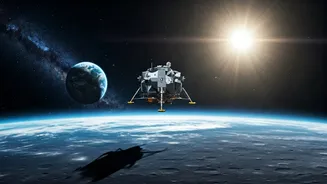
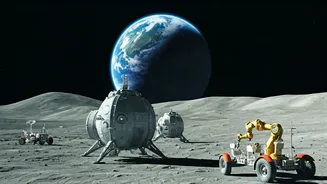
marking the first time humans have ventured that far into space since the Apollo era. [2, 7] While initially planned for 2025, the mission was delayed to resolve technical challenges, including issues with the Orion capsule's heat shield and life support systems. [2] Following this success, NASA has reshuffled its plans, designating Artemis III as a 2027 crewed demonstration in low-Earth orbit to test the commercial lunar landers being developed by SpaceX and Blue Origin. [13, 21] The first lunar landing of the program is now slated for Artemis IV in 2028. [7, 13] This new cadence reflects a more pragmatic, test-focused approach, ensuring all components, especially the privately-built landers, are ready for the gruelling task of returning humans to the lunar surface. [13]
The Commercial Heavyweights
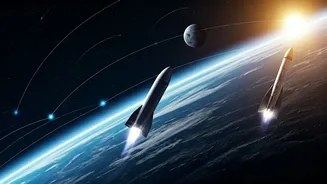
The commercial space sector has continued its explosive growth, with private companies now integral to the ambitions of national space agencies. SpaceX's Starship, the most powerful rocket ever built, has made significant strides. [11] Throughout 2025 and into 2026, a series of test flights demonstrated increasing capability, including a successful mock satellite deployment during Flight 12 in May 2026. [3, 16] These tests are crucial as Starship is not only key to SpaceX's Mars ambitions but is also the chosen vehicle for NASA's Artemis lunar landings. [11] Meanwhile, other players are solidifying their roles. Blue Origin is preparing its Blue Moon lander for a demonstration flight, and companies like Firefly Aerospace and Intuitive Machines are executing lunar payload contracts for NASA. [1, 26] This public-private model is no longer an experiment; it's the engine of modern space exploration, driving down costs and accelerating innovation. [28]
India's Ascent as a Space Power
India's space program has also had a landmark year, with major progress on its Gaganyaan human spaceflight program. The Indian Space Research Organisation (ISRO) is on track for the first uncrewed Gaganyaan mission in 2026, a crucial end-to-end test of the launch vehicle, life support, and re-entry systems. [6, 12, 19] This mission will pave the way for sending Indian astronauts, or 'Vyomanauts', into orbit. [19] ISRO has a packed schedule for the 2026-27 financial year with 27 planned missions, four of which are related to Gaganyaan. [9] This ambitious agenda, which also includes the development of a next-generation reusable launch vehicle and a robust satellite launch schedule, solidifies India's position as a leading spacefaring nation. [9, 12] The growth of the domestic space industry is also a key focus, with over 400 startups now contributing to the ecosystem. [20]
New Targets, New Ambitions
Beyond the Moon, the past year has seen a flurry of activity across the solar system. The ESA-JAXA BepiColombo mission is expected to finally enter orbit around Mercury in late 2026 after an eight-year journey. [15, 23] Missions to asteroids also took centre stage, with ESA’s Hera spacecraft arriving at the Didymos asteroid system to survey the aftermath of NASA’s DART impact. [15, 23] However, plans for Mars have been reshuffled. The ambitious joint NASA-ESA Mars Sample Return mission was effectively cancelled in its original form due to budget concerns. [5, 10, 18] This has created an opening for China, whose Tianwen-3 mission now aims to be the first to return Martian soil to Earth, with a planned return in 2031. [17, 25] Meanwhile, Japan's MMX mission launched in late 2026 to land on Mars's moon Phobos and return a sample. [15]