




The Icy Enigma of Europa
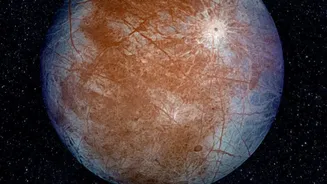
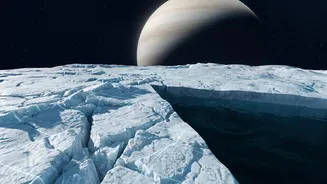
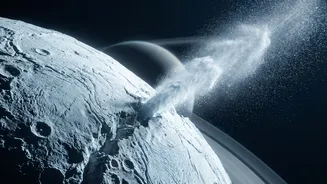
For decades, scientists have been captivated by Europa, one of Jupiter's largest moons. Slightly smaller than Earth's own moon, Europa is covered in a global crust of ice, crisscrossed with reddish-brown cracks and ridges. Data from previous missions,
like Galileo, provided strong evidence that beneath this frozen surface lies a massive ocean of liquid saltwater, potentially containing more than twice the water of all of Earth's oceans combined. This makes Europa one of the most promising places in our solar system to search for habitable environments beyond Earth. The presence of water is just one piece of the puzzle; for life to exist, it also needs energy and chemistry. The central mystery is whether this hidden ocean has the right conditions to support life, and how the surface and ocean interact.
Meet the Europa Clipper
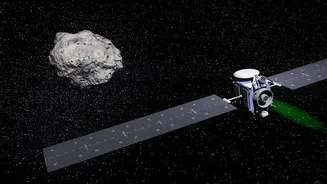
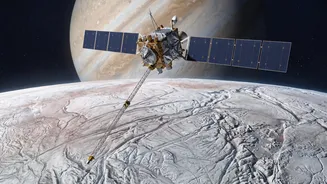
To investigate these tantalizing questions, NASA has dispatched the Europa Clipper spacecraft. Having launched in October 2024, it is on a long journey to arrive in orbit around Jupiter in 2030. Rather than orbiting Europa directly and exposing itself to Jupiter’s intense radiation, the spacecraft will make dozens of close flybys of the moon. During these passes, a suite of nine powerful science instruments will work together to study Europa in unprecedented detail. These instruments include high-resolution cameras, spectrometers to analyze composition, and a magnetometer to confirm the ocean's depth and salinity. But to see what lies directly beneath the ice, the mission relies on a single, remarkable piece of technology.
The REASON for Exploration
That technology is an instrument called the Radar for Europa Assessment and Sounding: Ocean to Near-surface, or REASON. It's an advanced ice-penetrating radar, the only instrument on the spacecraft that can look directly into Europa’s icy shell. Radar works by sending out radio waves and listening for the echoes that bounce back. By measuring the time it takes for these signals to return and how their strength changes, scientists can create a 3D map of what lies beneath the surface. The technology was honed by researchers studying Antarctica's ice sheet on Earth, adapting it for the frigid, distant world of Europa. REASON is designed to give us the first clear picture of the ice shell's hidden structure.
A Breakthrough in Seeing the Unseen
What makes REASON a breakthrough is its dual-frequency capability. It uses two different radio frequencies, 9 MHz (HF) and 60 MHz (VHF), to probe the ice at different depths and resolutions. The higher frequency VHF waves are perfect for providing a detailed look at the near-surface ice, identifying features like cracks or potential pockets of trapped water. Meanwhile, the lower frequency HF waves are designed to penetrate much deeper—up to 30 kilometres—with the primary goal of detecting the boundary between the bottom of the ice shell and the top of the liquid ocean. This ability to both map the shallow structure and sound the deep interior is a monumental leap in planetary science. It will not only confirm the ocean's existence but also measure the ice shell's thickness, a critical question that has long been debated.
Searching for Habitable Pockets
The Europa Clipper is not a life-detection mission, but it is searching for places that could be habitable. REASON is central to this objective. It will search for pockets of liquid water perched within the ice shell, similar to subglacial lakes found in Antarctica. Such lakes could be important because they might create environments with the right chemical mix for life. They could also act as a conduit, allowing chemical compounds created by radiation on the surface to mix with the water below. By mapping the internal plumbing of the ice shell, REASON will help scientists understand if Europa is a static, frozen world or a dynamic system where the ocean and surface can exchange materials—a crucial factor for habitability.
A New Era for Ocean Worlds
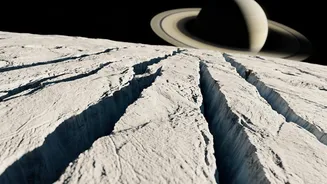
The technology pioneered for REASON represents a new paradigm for exploring icy worlds. Its success on Europa will provide a blueprint for future missions to other promising destinations in our solar system, like Saturn's moon Enceladus or Jupiter's moon Ganymede. The instrument has already proven its capabilities during a flyby of Mars in March 2025, successfully testing its systems in deep space. The data it gathers at Europa will transform our understanding from educated guesses based on surface features into a detailed, three-dimensional view of the moon's interior. This will not only answer fundamental questions about Europa but will also guide the design of future missions, such as a potential lander that would know the most promising places to search for evidence of life.