


A Sweet Discovery in the Milky Way
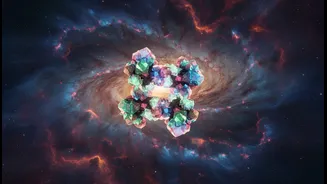
Scientists have detected a “true sugar” molecule for the first time in the interstellar medium, the vast clouds of gas and dust that exist between star systems. The molecule, called erythrulose, was discovered swirling in a molecular cloud named G+0.693-0.027,
located near the turbulent center of our own Milky Way galaxy. Using the powerful Yebes 40-meter and IRAM 30-meter radio telescopes in Spain, an international team of researchers was able to identify the unique chemical signature of this four-carbon sugar. While the discovery won't lead to cosmic candy, it has a much more profound implication. Erythrulose is a compound also found on Earth, notably in raspberries, making this discovery a relatable milestone in understanding our cosmic origins.
More Than Just Sugar-Coated News
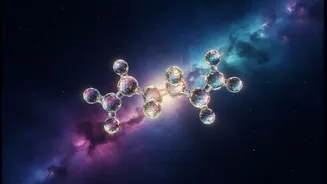
This isn’t the first time scientists have found sugar-like molecules in space. A simpler compound called glycolaldehyde was detected years ago, but it is not technically a true sugar, which must contain at least three carbon atoms. Erythrulose, with its four-carbon structure, is the first definitive simple sugar, or monosaccharide, found in the space between stars. Its discovery confirms that the building blocks for life are not just theoretical but are actively being formed in the galaxy. Sugars are vital for life as we know it; they help provide energy, form structural components of cells, and are key parts of our genetic material, RNA and DNA. Finding them in interstellar space strengthens the theory that the raw ingredients for life are common throughout the universe.
The Cosmic Chemical Factory
So how does a sugar molecule form in the freezing, empty void of space? The answer lies in what scientists call cosmic 'chemical factories'. Erythrulose is believed to form on the surface of microscopic, icy dust grains at incredibly cold temperatures around -250°C. In these extreme conditions, simpler organic compounds already present in the cloud, like glycolaldehyde and ethylene glycol, combine to create the more complex sugar molecule. These molecular clouds are dense nurseries for stars and planets. The discovery shows that even before a star system is born, the essential ingredients for biology are already being synthesized, waiting to be incorporated into newly forming worlds. This process suggests that the chemical complexity needed for life is a natural outcome of cosmic evolution.
From Stardust to Planets
The discovery of erythrulose in interstellar space provides a crucial missing link. Scientists have previously found sugars like ribose and glucose on meteorites and in samples returned from asteroids like Bennu. This suggested that these vital compounds were formed in space and delivered to young planets, including early Earth, through cosmic collisions. Finding a true sugar in a molecular cloud before it has even formed stars confirms this 'seeding' hypothesis is plausible. These interstellar sugars can become locked into comets and asteroids, which then act as cosmic delivery vehicles, potentially sprinkling planets with the ingredients needed to kickstart life. This doesn't mean we've found aliens, but it strongly suggests that the materials to build life are not unique to our solar system.