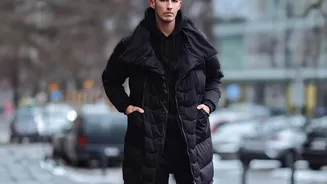








Every winter, the same question arises: why do I still feel cold under this huge, heavy jacket? The answer may not be a bigger coat, but a smarter system. The secret to true warmth lies not in thickness, but in the science of layering.
The Problem with a Single Heavy Layer
A single bulky garment,
like a thick cotton hoodie or a heavy wool parka, seems like the obvious choice for cold weather. It feels substantial, so it must be warm. However, this approach has two major flaws. First, it offers poor adaptability. As your activity level changes or you move between indoors and outdoors, you’re either too hot or too cold, with no middle ground. Second, and more critically, it fails at moisture management. If you start to sweat, that single heavy layer, especially if it's cotton, will absorb the moisture and hold it against your skin. Wet clothing robs your body of heat up to 25 times faster than dry clothing, leaving you colder and clammier than before.
The Science of Trapped Air
The real principle behind staying warm is insulation, and the best insulator is stationary air. A layering system works because it creates multiple pockets of air between the garments. Your body heats this trapped air, forming a protective thermal barrier that is far more effective than the insulation provided by a single, dense fabric. Think of it like a double-pane window; it’s the air gap between the panes that does most of the insulating work. Each thin layer you add contributes another one of these insulating air gaps, multiplying your warmth without adding significant bulk. This allows for greater freedom of movement compared to a restrictive heavy coat.
The Magic of Synthetic Blends
This is where the base layer becomes the hero of your winter wardrobe. The layer closest to your skin has one primary job: moisture management. This is where synthetic blends, typically made of polyester, nylon, and spandex, truly shine. Unlike natural fibers such as cotton which absorb moisture, synthetic fibers are 'hydrophobic', meaning they repel water. Instead of soaking up your sweat, they actively push it away from your skin to the outer surface of the fabric where it can evaporate. This process, known as wicking, is crucial for keeping you dry and, therefore, warm. While merino wool is also an excellent wicking material that insulates when wet, synthetics often dry faster, making them ideal for high-exertion activities.
Building the Perfect Layering System
A complete system consists of three parts. First is the base layer, a snug-fitting synthetic or merino wool top and bottom designed to wick sweat. Second is the mid-layer, which is your primary insulator. Its job is to trap the heat that your body generates. Materials like fleece (a polyester fabric) or a lightweight down or synthetic-fill jacket work perfectly. They are breathable, allowing the moisture wicked by your base layer to continue its journey outward. Finally, you have the outer layer or shell. This layer’s purpose is to protect you from the elements like wind and rain, which can steal your warmth. A good shell is windproof and waterproof but also breathable, letting sweat vapour escape so your inner layers don't get damp.